FIRE STARTER

FIRE STARTER

Theo thinks he’s Christ.  At my first attempt to eat breakfast in the retreat’s communal dining room, he’s shouting:

‘I can save some of you but I won’t be able to save all of you!’

‘That’s fine, Theo, do whatever you can,’ Simon the warden replies, pulling him away

Later, as I try to eat, I hear sobbing coming from the lounge.

Simon’s head appears around the doorway: ‘Theo has had an unfortunate accident, kids,’ he says, ‘and won’t be staying with us for a while.’

Simon’s wife, Ursula, wears tight purple leggings that smell of citrus and sandalwood. She looks young for fifty, and speaks as if she’s a WW2 German spy expertly repeating dated bookish English, a Teutonic phrase occasionally intervening between exacting vowels and corrective grammar. She is also a healer.

I lie on my bed, eyes closed, head propped on a mound of pillows as she kneels beside me, lightly stroking my left temple, my face turned into the soapy incense of her legs, soothing purples filling my eyelids.

‘Breathe in the calm beautiful energy of God’s nature. God loves you if you are good, and he loves you even more if you are bad. God loves you and so does everyone else.’

‘Even Theo?’

‘Especially, this Theo,’ she replies.


At lunch, a woman called Ruth helps out in the dining room; a silent waitress in her early thirties with piercing eyes peeping out from under a thick dark fringe. I’m struggling with finishing my salad and she notices, sighing slightly as she takes the plate away, her hip brushing the corner of the table, making my glass tremble.

I notice the fine bead of a gold chain around her neck, the unmistakeable outstretched outline of a crucifix nestling under her blouse.

‘Used to be a nun, we’re lucky to have her,’ Simon tells me later in the lounge. ‘Doesn’t say much; goes with the territory I suppose.’

‘Maybe it was a silent order.’

‘No, I don’t think so, unless you know more than I do. Now, Ursula tells me you saw purple in the healing session. That’s a good sign, purple is the colour of celestial healing, just don’t think too much about her body, that’s my domain.’  He notices my cuts and scars.  ‘Tickle them away?’

‘No, Christ, no,’ I say, and get out of the room.

‘Tickling is God’s way of making uptight shits loosen up,’ he shouts after me.

 My heart is racing as I climb the stairs to my room. When I look back, Ruth is standing at the bottom of the staircase. She’s smiling, and it’s such a beautiful smile.


A note arrives under my bedroom door that night: ‘Simon wants me dead. You need to help me.’ No signature, no clue to who’d written it, except it’d been scrawled in green ballpoint on an A4 page torn from a notebook, its left side frayed and jagged. Find the green pen, and find the notebook and join the tear left by the torn-out page like Poirot might do? Instead, I rip the page up and drop the pieces in my bin like a guilty person might do.

Later, I dream of Theo standing in the middle of the lawn under an enormous yellow moon but as I call out to him, he slides the reconstructed note into his mouth like he’s feeding a shredder, regurgitating it seconds later like ticker tape onto the grass, and, when I wake up to check my bin, all the pieces of the note have gone.


At breakfast Ursula suggests I’m spending too much time on my own, and invites me to a group hug session taking place in the lounge at eleven.

I find a quiet corner of the garden so I can collect my thoughts before the session. But Theo is waiting, a bloody bandage wrapped loosely over his head. He sucks on a cigarette, a glint of red in his eyes when he notices the scars on my arms.

Before I can get away, he starts: ‘I knew you’d come. I was here in the garden last night but you weren’t ready to listen to my thoughts. So, I climbed on top of a hill but the masses weren’t receptive either. I stretched out my arms to give them a sign, drew the clouds apart as if I was pulling open a pair of curtains – ‘

‘Theo, you’re tired, why don’t you – ‘

‘Shut your mouth! I divided the sky in two, one half, the light side, for the good and the righteous, the second, the dark side, for the bad and the sinners. I didn’t know what side to put you in but I know where to put him!’

Out of the corner of my eye I see Simon arriving with a big heavy-looking branch in his hand.

‘Fuck off, Theo!’ he shouts.

Theo calmly stubs the cigarette out in the palm of his hand, and turns to me. ‘You can save yourself, it’s up to you, but a great darkness is coming, I promise you that.’

As Theo walks away, Simon leans into me, his breath reeking of alcohol. ‘Don’t feed the nutcase; starve him or batter him, or he’ll batter you. Here, you might need this,’ and he hands me the branch.

I take it from him

He laughs. ‘Oh, please, just drop it, I was joking.’

I walk back towards the house. When I look up, Ruth is standing at my bedroom window. She gives a shy wave to suggest she’s seen it all, and is on my side, and is there to help.


The hug session starts with a pep talk by Ursula, suggesting that if someone becomes aroused to just ignore it, as it’s ‘perfectly normal for youth to react in this way when touched’. She also mentions the solar eclipse that is going to happen tomorrow. ‘Apocalyptic times’ she says, ‘we must dig deep and harness positivity, white Christian magic, not black, and reach through darkness towards the light of the stars and beyond. Yes?’

‘Yes,’ we murmur.

There are four of us at the session − how did the others get out of it? –Ryan, Saskia, Helen and me. Saskia is slumped in a wheelchair and I’m relieved when I’m not coupled with her. That leaves Helen, who is as embarrassed and shut-off as I am.  We approach each other hesitantly, my palms leaking dread, and our eyes meet for a split second before we look quickly away and nervously laugh. When I put my arms around her I can feel sweat through her shirt along her back. She whispers, ‘I hate this so much’ in my ear.

‘Good,’ says Ursula, ’see us humans are meant to touch; it’s how we came into the world, after all. And it’s not so bad, is it?’ Saskia’s motorised wheelchair makes a nervous sound and Helen and I blush.

‘Now, you need to take off the socks because we are going to get to know each other’s lovely feet. Feet are important, their soles our imprint on the earth, their name no accident for all bodies, all souls are welcome in the kingdom of God, in nature and in this world: one and the same, all of us, Amen.’

‘Amen,’ we say and begin to slip off our socks, a pungent febrile desperation filling the room; Ryan on his knees as if in prayer, tugging away at the clasps on Saskia’s heavy orthopedic boots.

After a few minutes, with Helen’s feet imbedded in my lap, slippery and glistening with sandalwood oil, Ruth arrives with a tray of tea and biscuits. Our savior! She smiles, a wry kink at the right-hand corner of her top lip, her eyes as calm as a still summer lake, sparkling, reflecting warmth, welcoming us into the deep.


I write about Ruth on my bed that night, her beatific smile, her solid naturalness and quiet unusual beauty, the otherworldly way she sometimes looks straight at me, holding her gaze a little too long. A subconscious love heart doodle frames her name as I write, the ‘R’ and ‘h’ in Ruth metamorphosing into two figures, he and her, lying head to tail, the valley of the ‘u’ like a cupped breast, the ‘t’, I have no idea about the ‘t’, but my mind is melting.

Then, I hear the sound of breaking glass and shouts from outside: ‘I want my bed back, so, for Christ’s sake, get down here and let me in!’

‘Go away, Simon, sober up and come back in the morning!’

‘I’ll smash another window, so help me. Now let me in or I’ll torch the house and everyone in it.’

‘Simon, I’m ringing the police’

‘You do that, Ursula, and I’ll torch them too!’

 I look out of the window, and can just make out Simon running away from the house, across the lawn, and disappearing into the trees.


The morning of the eclipse and the house is in a heightened expectant state. In the lounge, Ursula is alternately chanting and praying with Saskia. Before lunch we’re given our protective glasses and join together in a circle in the garden to hear Ursula speak:

‘God, bringer of light, bringer of life and health for all, please will you allow us a moment of darkness to appreciate your energy once again, and then allow us to step into the warm rays of your forgiveness and light. Amen.’

‘Amen,’ we reply.

I go back to my room to ready myself for the eclipse beginning, but the sky is already darkening, the elements tightly sprung, a shrill warning call from birds in the trees, dogs wildly barking, sheep in the fields bleating like banshees.

I rush down to the garden. I’ve forgotten my protective glasses but I realise they won’t be needed. It’s very cloudy; there will be no dramatic change to the sun to view, no glowing emerging rim of light to hide from. It’s become spectacularly dark, airless, atoms all confused; animals that had been unsettled and vocal suddenly silenced.

I trip over something large and stumble forward, falling onto the ground. Ursula is on all fours, slapping, ‘smack’, ‘smack’, ‘smack’, the face of a man lying on his back on the lawn.‘I need to wake him or he’ll start fitting again. Here, help me roll him onto his side.’

 I crawl over and pull his body towards me.

‘Thank you,’ she says, and reaches into his mouth to pull back his tongue, Simon’s legs twitching, a moan from deep inside his chest confirming that he’s still alive.

Tall red spikes of light jag above a bush behind them, and Theo arrives on the lawn swinging a flaming stick above his head. He runs past Saskia who dances unsteadily around an upturned wheelchair. Sparks scatter, the crackling sound of scorched wood; the pungent smell of sulphur as he gets near to us. Ruth walks purposefully from the house to stand in his way, licks from the stick’s flame reflected in her eyes. She holds out her arms to welcome him. Theo stops and prods the stick toward her, flickers of fire falling to the ground and dying by her feet. She stays still, her arms held open, and smiles. Theo drops the stick and walks slowly into her embrace. She holds him, and then frees one arm to invite me in too.

I feel myself give in as she rocks us, strands of her hair across my lips and in my mouth, salty and thick, the scent of fresh amber soap on her skin. She kisses me, her lips warm and soft, and kisses Theo, then turns us around so we are facing each other, she magically in-between. I can see crude green ink love hearts on Theo’s cheeks. We hug, but as light returns, she’s gone.

Theo and I hold on to each other, the scars on my arms disappeared, the grass catching fire behind us.


*

Fire Starter came second in this year’s RTÉ Short Story Competition in honour of Francis MacManus. Hear actor Rory Nolan do a brilliant reading of the story here: https://www.rte.ie/radio/radio1/clips/22157062/
Posted in Uncategorized | Leave a comment

RICHMOND PARK


In a photo I’m leaning with Mum against a railing in Richmond Park. I’m seven and Mum is laughing, holding a cigarette in one hand, reaching out for me with her other. It’s late autumn, and golden leaves are turning to rust and lie scattered across the grass. I can smell the familiar sweetness of her favourite perfume, which I know is called Fidji because she tells my father off if he doesn’t buy her the right one. She’s wearing a brilliant white coat bought from Bentalls earlier in the day, and looks like a film star, something of the hedonism and lived-in wiliness of Ava Gardner, but her need to reach out for me tells me she’s still my mum.

In the photo I’m looking at her laughing and reaching out to me, my expression happy but also slightly quizzical, marvelling, but already not quite believing what I’m seeing. For though I have many photos of Mum laughing at a camera, and she maintained a wicked sense of humour right up until the end, I struggle to remember many episodes of her laughing as much in life (though if I dared to dig deeper I’d remember more), the depression that took over in late middle-age and for the rest of her life, crumpling her features into a perpetual grimace, colouring my mood and memories of her, distorting the happier mental pictures I try to focus on and hold inside.

Richmond Park was where she was happy but it was also significant in her downfall. If there had been an inquest into her death in her mid-seventies, I might have brought in this picture as an exhibit, as background evidence of how Richmond and its park offered refuge but also shadowed her decline.

Between World Wars, Mum’s father had died from TB, his lungs slowly rotting away after being gassed on the Somme. Mum’s mother, who had only been eighteen when she’d given birth to her, took off to catch up on the life she felt she’d missed out on, to let it all out amidst the delirious, unbridled twenties, a debauched sepia print of her on an ocean liner, cigar in mouth, lying across the laps of two men in cockeyed sailors’ caps, who looked like they’d just drunk the bar dry.

Mum was seven, the same age as I am in the photo, when she’d been dumped in an unforgiving convent in India, spending the next ten years holed up there, never visited by her mother. Attending on a meagre army widow’s scholarship, she was treated worse than the other girls – more chores, cheaper meals, and harsher punishments – and didn’t leave the grounds until her teens, when her grandmother and aunt finally rescued her for summer holidays to their home in Richmond. In 1942 she turned eighteen, finally left the convent, joined up as a Wren, and moved in with them. ‘The war years’, she’d often say ‘were the happiest I’ve ever been’, the excitement and risk somehow enlivening her, the fleeting romances (she was proposed to three times), and comfort and delight of walks and picnics with her newfound family in Richmond Park.

As long as I can remember Mum wanted to return to live in Richmond, but she never got her wish, only posthumously getting there when she stopped eating after her suicide attempt by swallowing a bottle of sleeping pills had failed. In the long shrinking countdown to her days, she repeatedly asked that my sister and I scatter her ashes in Richmond Park’s Isabella Plantation.

Months after her funeral, we stole at dusk into the plantation, so fewer people might see us, as if we were committing an illicit act best kept from view. We found a cluster of bushes away from a path and I took the urn out of my bag and dug a hole for her ashes to go in. When I opened the urn, a splutter of wind lifted a mist of grey ash over my face and hair. Hysteria took us over and we laughed and couldn’t stop. Eventually, I shook my head and spat out the ashes, and we patted them down into the soil and tried to say a few appropriate funereal words. Whether it was the cold, the hysteria, or the sadness and bitterness of her final years, it became impossible to say anything with real conviction. And inevitably when we returned a year later, we couldn’t locate the bushes where we’d scattered the ashes – more laughter, more hysteria.

Ten years after scattering the ashes I went with my wife and daughters to live in Richmond. It sometimes felt like an act of betrayal towards her, though I know she’d have been mostly happy for us too. She was everywhere, accompanying us on walks along the Thames towpath, queuing in the perfume section in Bentalls, outside her Gran’s Victorian redbrick ground-floor flat in East Sheen and most of all in Richmond Park, even though I sometimes did my best not to see her there.

There is a photo of my daughters taken in Spring in Isabella Plantation, aged four and five, in bright purple and pink Chelsea FC tee-shirts (Mum, like her mother before her, supporting Arsenal to maintain a phoney and mischievous rivalry between us), laughing and mucking about in front of a riot of Technicolor rhododendrons.

We never again tried to find Mum’s ashes on the many visits we made there, but leaving the park we had to pass the railings where I’d stood with her decades before. Mum still reaching out, pleading for me take her hand; so now, I do the next best thing and write it all down and get to hear her laughter and hold her once again.


*Richmond Park was published this year in ‘Modern Nature Anthology – Responses to Derek Jarman’s Modern Nature’, Artful Scribe/John Hansard Gallery, Edited by Joanna Barnard. https://artfulscribe.co.uk/shop

Posted in Uncategorized | Leave a comment

MONTY MODLYN

MONTY MODLYN

Monty Modlyn hosted a late-night phone-in on LBC in the 1970s. He was warm, cockney-cheeky and consistently upbeat with callers who rang in.

‘Monty, I put all the washing in like it said to, and it came out proper mangled. Ruined it was.’

‘Oh, sweetie, I’m really sorry to hear that. What’s your name by the way, my love?’

‘June.’

‘June, that’s a lovely name, and a lovely month. Now, June, dearest, and I’m not trying to be cheeky, but maybe it’s a chance for a new wardrobe?’

‘Oh, I don’t have money for that. Not since my husband went and everything.’

‘Oh, June, I’m so sorry, dear. When did he die?’

‘Oh, he’s not dead, Monty, he went off with my sister.’

‘Ah! Definitely time for a new start, my girl: out with the old and in with the new, as my mum used to say.’

‘Your mum was right, Monty, I’ll buy a dress in the sales tomorrow. Why not?’

‘Yes, why not, my love, and you take care and show a bit of ankle when you can.’

 Den, Paul and I were fourteen. It was New Year’s Eve, 1975. We were in Paul’s bedroom listening to Monty’s programme, taking the mickey out of him and the callers, and shutting out the world around us. Even though I giggled inanely, I was secretly seething – how had it come to this? Inwardly I longed for better times, imagining other pupils from school in reverie, dancing and necking the night away.


The numbing comic mediocrity of that night mirrored the years to come in my twenties and thirties after I was diagnosed with myalgic encephalomyelitis (ME). A sentence taken in relative solitary, life happening elsewhere, ceaseless days of drudging melancholy enlivened by snippets of humour and companionship, a life stubbornly endured in the hope of better times to come. 

When I first became ill at twenty-six, my friends clubbed together to send me, like an Edwardian lady taking restorative waters, for respite cure at Tyringham Naturopathic Clinic. The residents were moderately wealthy (it wasn’t Champneys: here was faded grandeur), often overweight and emotionally fragile, mildly invalided, and occasionally included elusive celebrities seeking a bolthole from the world. A TV star was recovering from relationship upheavals in a suite on the top floor when I was there, and only appeared occasionally at breakfast in a purple chiffon dressing gown and giant sunglasses, to peruse and touch various fruits in a bowl before rejecting them, then disappear up the stairs with a steaming cup of hot lemon water trembling in her hand, her famous red hair aflame and pouring out behind her. 

In the ornate gardens, surrounded by statues of Greek gods and marble nymphs, lay the longest man-made pool in Europe. Sun worshippers sitting around the pool, mainly female, average age sixty plus, were sometimes drawn to the presence of a frail young man in a swimming costume lying by the water but never getting in. I was that young man, and was soon being mothered by various older women, and enjoying the attention. Betty told me about her daughter, who had recently been diagnosed with ME, then also known post-viral syndrome (I never liked that word, ‘syndrome’). ‘That’s what you’ve got, I stake my life on it!’ she said excitedly. ‘And what you need to do is give in to it!’ 

Tyringham was built over powerful ley lines, and attracted shamans, white witches and spiritualists. Betty’s friend, a small nervous woman with beetle-black eyes, declared that she was a healer and told me I was a healer too, but that I was too open, and my energies were being drained by negative forces. ‘Protect your centre with golden light,’ she said, her hand drawing an invisible circle around my bare stomach, ‘particularly when your mother is around.’ 

Not all medics believed ME was a real illness. Fortunately, my GP was more enlightened. He’d read about the condition and when I saw him after Tyringham, he offered the same diagnosis as Betty. The diagnosis, however contentious, would offer some temporary protection and sanctuary. There was a problem, though. I remember an Alan Bennett play shown on television when I was about fifteen. A bourgeois party was taking place in a grand house. A well-coiffed woman strode in and declared with gusto, ‘I have cancer!’ and, after initial silence, received a smattering of polite applause. Betty was well meaning but also triumphant in her diagnosis, but ME was nothing to crow about. It lacked real legitimacy, no lasting badge of honour would be awarded for fighting it or staying the course, and the controversial diagnosis soon became a curse. 

Advice for getting well was so contradictory. Rest or exercise? Fight or give in? Live with the condition or live despite it? Any kind of exercise, even gentle walking, soon exacerbated muscle pains and weakness, but should I carry on and do it anyway? Later on, medics and therapists suggested carefully graduated exercise as a possible way forward. But for someone whose energy had long gone, and who was impatient and wanted quick results, their strategy was near impossible. In any case, I rapidly found that I could do very little except lie down and fester, and dwell on my symptoms. Even reading was too tiring, my eyesight and brain fogging after a few lines. I was confused, berating myself for not trying hard enough to get well but fiercely hurt and defensive if I was disbelieved or if someone intimated – as a few did – I was faking. OK, bring it on: Pretentious. Moi? Paranoid. Who’s been talking about me? Hypochondriac. Maybe? But if I were, couldn’t I also be ill? Don’t know. Well, fuck you, then!


I left my job as a student nurse, and vacated my room in a co-op in New Cross to go back to my parents and their tiny flat in Haywards Heath; my bedroom big enough for a single bed and a small CD player. I disappeared into a stupor, lying in bed for maybe twenty-three hours a day for the first six months. Ethereal voiceless music, glorious cascading waves of kora strings, hoots and rumbles of sixties, spaced-out Miles Davis, or deranged celestial whoops and enchanted gobbledegook from the Cocteau Twins’ Liz Fraser were a constant, sometimes soothing, occasionally unhinging, companion. My mind would be transported to somewhere else, high, tripping, heat through my temples, my body left for dead on the slab. 

I had no choice but to try and sleep my way through, getting up to eat with my parents in the evening, and watch a little television. Dennis Potter’s Singing Detective took me over and became a totem for my submerged psyche, the convoluted detective plots and blackly comic forties hospital crooning, the anti-hero Marlowe’s hot peeling psoriasis skin, his diseased erotic dreams and surreal cinematic suffering, all mingling with my own confused imaginings and disconnection from the real (healthy) world. My parents loved it too (echoing our shared enjoyment of Potter’s Pennies From Heaven when I was a teenager). We laughed at the incongruity of uptight doctors and nurses dropping bedpans and stethoscopes to suddenly tap dance and lip-synch to Bing Crosby and the Andrews Sisters (‘Don’t Fence Me In’ carrying particular resonance), Dad smiling over at my glassy-eyed infatuation with Marlowe’s nurse played by a young, sexy Joanne Whalley. 

Listless days in a gloomy half-light were often accompanied by cassettes of books narrated by friends. These included a painfully arch reading of Gertrude Stein’s Blood on the Dining-Room Floor, and my friend Beatrice’s feat of endurance reading, Carson McCullers’ The Member of the Wedding, in a strange, shaky Southern States drawl, where sometimes she was so tired it became impossible to decipher what she was saying. Words and phrases got lost along the way, but the message came through and I was hooked, twelve-year-old Frankie’s story resonating with my own sense of longing and despair. Frankie is bored and trapped by life and becomes obsessed by her brother’s wedding and with his bride. Beatrice’s drawled narration created a strange atmosphere, another level of recognition and attachment to Frankie’s predicament and spirit:

‘Because she [Frankie] could not break this tightness gathering within her, she would hurry to do something. She would go home and put the coalscuttle on her head like a crazy person, and walk around the kitchen table. She would do anything that suddenly occurred to her – but whatever she did was always wrong … having done these wrong and silly things, she would stand, sickened and empty, in the kitchen door and say: “I wish I could tear down this whole town.”’ 

Another friend, Tom, sent a tape of Chinese meditation and breathing exercises, narrated in his deep, resonating actor’s voice. From the poem of Fang Sung Kung, Tom spoke evenly and encouragingly:

With a high pillow I lie on my bed;

I keep my body comfortable and relaxed.

I breathe in and out naturally,

And say the word quiet and relax silently.

I think of the word quiet as I inhale,

And the word relax as I exhale. 

I never got near to the end of any tape before sleep set in, but the familiar voices were welcome, and my friends’ acts of kindness made me feel that I wasn’t alone and helped keep me going. 

I also made tapes for them, endlessly stop-starting cassettes, jamming together ‘record’ and ‘play’ buttons, trying to find a feel, a merging flow and theme to the music, carefully nuanced to fit the mood and taste of each friend, tape boxes scattered across my bed, my head zoned in and frazzling. I was moronically obsessive, barely able to talk, let alone take a break for the toilet; nothing mattered more at that moment, and each tape completely exhausted me. Sometimes I’d finish only to find the important final track wouldn’t fit (days before digitised music and cue times) so I’d start again, taping over, scribbling again over my cramped spidery writing on the index cover, editing out the guilty overlong track to fit in two shorter ones: Fela Kuti’s expansive polemic ‘ITT’ giving way to Leonard Cohen’s ‘I’m Your Man’, neatly segueing into Al Greene’s ‘Belle’. Damn, J. J. Cale’s ‘Magnolia’ would have worked better. Start again! 

Being ill and marking time at home was familiar fare. I’d experienced fevers and pneumonia as a young child in Mombasa, a quiet shuttered room (waiting for my parents to come in and check on me), delirious daytime sleeps held in the safety and relief of cool white sheets, then repeated colds and flus throughout puberty and into my teens. 

At school in Sussex, I missed a day a week on average, often Thursdays (double chemistry), occasionally feigning symptoms to encourage sympathy and more time off. I once heated the trusty family thermometer in a mug of tea. The mercury shot fatally off the scale. When I retrieved the thermometer, its end burst and mercury dolloped onto the floor, separating then re-coalescing, then separating again as I tried to scoop it up with a spoon. A line of small silver balls slid under the fridge and I started to panic, fearing mercury was as poisonous as arsenic and as explosive as plutonium. 

In the early stages of ME, I contracted pneumonia and was sent to Guy’s Hospital. After a week I recovered enough to go onto the ward rooftop terrace. It was like a World War Two TB sanatorium garden, only high up and surrounded by concrete and glass: young men in regulation striped dressing gowns flaked out on deckchairs, basking in the sun, some with eyes closed, no longer moving, as if they were already dead, others chatting and playing cards. I shared a cigarette with a man about my age, sitting on his own. He showed me fine, hard, grey pellets running under his skin and along the veins on his arms and legs. 

‘I tried to kill myself by swallowing mercury,’ he said. ‘It didn’t work, obviously.’ He saw I looked relieved. ‘But now they’re saying they can’t do anything. The drugs to reverse the mercury’s flow haven’t worked and sooner or later the mercury will collect itself in my heart. And that will be that.’

‘Jesus!’ I said.

‘Exactly,’ he replied, with a kind of grin. 

The drag on the cigarette made me dizzy and breathless. I gave my pack to him. ‘Thanks, and don’t worry, it won’t be wasted, I’ll have plenty of time to finish them,’ he said, lighting up another. He added that death would be agony, as his liver was already toxic. Yet he sounded so matter-of-fact and gave an ironic ‘thumbs up’ when I left him. His slow, monotone voice haunted me for weeks after I was discharged.


When I was a child, Mum had enjoyed my company when I was off school, sometimes colluding in my illness to keep me home. She loved our slow, giggling dances (as did I) when I returned from school for lunch, a frozen Birds Eye TV meal in the oven, Frank Sinatra’s ‘Cheek to Cheek’ circling on the turntable. But when I arrived home from Guy’s Hospital, she wasn’t there. She’d suffered a breakdown and was recuperating in a small psychiatric hospital in Hove. We visited her in her dormitory, a row of pictures of me, my sister and my nephew, arranged on her bedside locker, and while we were there she never stopped crying. But she had close friends in hospitals, a strange boarding-school camaraderie, someone to look out for her, and an old woman with long, wild, grey hair came over and hugged me and said she’d been praying for me too. Mum looked on sobbing, and said, ‘I love you so much but I’m an awful mother, I should be there for you!’ 

On her return, she wanted to smother (the extra ‘s’ is mine) me, my illness relegated and merged into her own anxieties, disaster storylines and maternal guilt; the tragedy of the perfect son cut down by a sickness no one understood, and a pitiable mother who was unable to help. After her drugs kicked in, she resurfaced and did her best, an ally of sorts, and we tried to help each other. But Mum’s melancholic fateful take on things was dangerous. I tried my best to be practical and positive about my health – it was the early days of my illness, after all – but a heroic yet catastrophic narrative was sometimes hard to resist. I put my own dark comic spin on my predicament, lacing my illness with stories of slapstick medical mishaps and a surreal gallows humour. The comedy of misfortune sometimes devalued things, pulled the rug from what I was going through, and helped cast me as some kind of hapless idiot. But if I was serious and told things how they really were, I worried that I came over as needy and overly intense: one extreme to the other with nothing safe or easily digestible in between. 

Mum would wait by the front door of the flat, jumping at it as soon as Dad turned the key to come inside. A catalogue of woe and recrimination would follow, Dad fending her off and walking breathless down the corridor, his energies spent by the time he looked in on me. Once he stopped me in my tracks (just as the plaintive, lonesome whistle was about to blow): ‘I’m sorry, I know you’re going through it, but I can’t listen straight after your mum has had me. I’m tired, but I’ll come in later and you can tell me how you are then.’ I understood but my eyes smarted with hurt. I’d hear him go into the kitchen where Mum waited with an ensnaring cup of tea, and she was off. After a while came a pained roar: ‘For Christ’s sake, just shut up!’ My own voice quietened in solidarity with his plea for silence. 

My sister was worried that Dad coping with me being ill at the same as dealing with Mum’s depression might kill him. The guilty family story of Dad’s heart attacks following a marathon weekend of summer gardening in 1974 still resonated. I remember his flagging energies on that Sunday, regimental lines up and down the garden, the aggravated, guilt-inducing sound of the mower, and his obsessive impatience to get it all done in one go. We determinedly clung on inside, trying to drown things out with the TV (‘The Big Match’) turned up, feeling bad but also staking our right to relax, to be lazy and not help, justifying inaction with the rationale that it needn’t all be done in one go. 

Dad didn’t die, but after his heart attacks, any time he was late home from work would have Mum wringing her hands and saying, ‘He’s gone, I can tell, we’ve just got to get on with it.’ Now my sister was worried that my illness and its demands would finish him off for good. Life repeats itself, and, like Dad, I have no patience and rush headlong into things, hoping my fragile energies will carry me through. Moving house, I’ll frenziedly pack into the small hours for days before, and then have the new house (magically replicating the one before) settled, boxes unpacked and flattened for recycling, pictures hung, kids’ toys stacked, books and CDs on shelves, only a couple of days later; and then I let go and collapse.

It’s always been my choice to push myself and I’ve never listened when someone said ‘slow down’. Not much changes: I’m writing about past illness while I’m ill with flu, flirting with reality, those loose shadowy sentences and opaque turns of phrase. I’ve also been nursing my eight-year-old, who’s had the same flu, while writing about myself being off school being nursed by my mother. 


My first venture out of my parents’ flat to an ME sufferers’ group was new and yet also horribly familiar: the Sussex village church-hall setting, resourceful flower arrangements (‘Can they really be plastic, Vicar?’), Women’s Guild posters, Round Table litter initiatives, the generously flowing teapot, Barley Cup (I hate Barley Cup) and Fairtrade instant coffee, homespun shawls for sale for use on frozen, immobile legs. A well-meaning, parochial Archers vibe I’ve always recoiled from. Then the sight of mummified limbs bound in the same cheerfully patterned shawls, sticking out from wheelchairs parked up in the front row, overbearing, anxious parents waiting behind to ride their kids’ chariots like Ben Bloody Hur, young women crumpled in the chairs, their deathly pale faces, disarmingly insipid smiles and angry eyes, coiled in on themselves but wanting to shout: ‘Understand me, I’m sick, you fuckers!’ 

Speakers talked about gaining acceptance, applying for disability benefits and where best to buy natural sheepskin pads to prevent bedsores. It was overwhelming, the air full of desperate coping, defeat and hurt, and I wanted to escape. But I listened, my lips slowly separating into the same insipid smile, the hint of a grimace; and next meeting I’d be wheeled in on my own wheelchair. 

My rickety collapsible chair was hired from a local charity and was too small. I hated it, and I hated being in it. I felt self-conscious in public, though occasionally I indulged in the mystery and fantasy of a heroic young man (Firefighter? Soldier? Or poet?) tragically struck down in his prime.

‘Oh, it breaks my heart to see a fit-looking young man like you in a wheelchair.’

‘I ain’t fit, lady, but thanks for your concern.’

‘Oh, you lovely cheeky boy!’ 

I could stand up unaided and walk a short distance, so the wheelchair was used for journeys over a few hundred metres, to avoid exhaustion and overexerting my muscles. The wheelchair was hard to push and I’d sit rigid, my muscles tensed, my eyes closed (wishing it all away), feeling guilty for making a fuss, always questioning if I should be in it at all: cue the accusatory column (‘Monsters Amidst Us’) on page seven of the local paper with a picture of a perky, seemingly able-bodied driver climbing out of his Ferrari, which he’d just parked in a disabled parking space. Of course, there were many reasons why his sports car might have qualified for a disabled permit, weren’t there? 

But tongues like to wag, and if I stood up and miraculously walked from my wheelchair, I confounded expectations. When my friend Beatrice and I arrived on a windy day on Seaford seafront, we couldn’t stop laughing, as, first, we attempted to lift the wheelchair out of the boot, and then fold it out and reattach its missing wheels. She pushed off and a front wheel fell away and I tipped forward onto the floor. We were in hysterics. An old couple in a car visibly tutted, and the woman tapped angrily on her passenger side window as if we had transgressed some convention of disabled behaviour and use of mobility equipment. The following week’s page-seven headline could have set the letters page on fire. 

At my third local ME Association meeting (the second meeting, attended in my new wheelchair, had passed in a fevered blur) I met Adrian. As if attending an old-fashioned introductory agency for the enfeebled, an older woman spotted we were both men and both young, and pushed our chairs together. We smiled shyly at each other, but I detected a welcome energy in his obvious discomfort at being there, a glint of red and anger in his eyes. We ended up talking about music rather than being ill, a mutual way of escaping, and would meet later to swap tapes we’d made for each other, my esoteric tastes for relaxing to kora music and Philip Glass less to his taste than Public Enemy and the wonderful testosterone-filled Soweto beats he made for me. He was new to the game, and I was cast as an unwilling veteran, ready to show him the ropes, but we both preferred to hide from view and neither of us would attend a meeting again. 

I hunkered down at home, endlessly sleeping, numbing pain and unwanted thoughts with the prescribed opiate DF118: a low-key medicinal heroin, a soft landing, a warm cave to crawl into, to lie up and wait. Despite its unfortunate effect of bunging me up, it was insidiously addictive and even more soulful than the Valium I used to steal from Mum’s handbag when I was a teenager. 

I felt so ill and alone in my illness that sometimes I fantasised I might not wake up from a sleep. More often, though, I went to sleep wishing I’d wake up feeling miraculously better. But each day was Groundhog Day and I woke wrung out, a heavy head on the pillow, bones and muscles aching, brain slurring, my vision blurred at the edges. 

ME took away my ability to read books. Ironic when I had so much time, but a page would finish me off, words jumbling, my eyes dropping between the lines, white noise, sugar-melt between the letters. Brain scans at St Bart’s and St Thomas’s would later show that there was neurological brain damage, reduced blood flow at the brain’s stem affecting various cerebral hemispheres and cognitive functions. While brain stamina was reduced and the parts of my brain that took in and utilised information were compromised, the sections of my brain to do with imagination became increasingly stimulated and warped: endless fitful, drooling daydreams and deep REM sleeps full of surreal colour and vibrancy. As soon as I closed my eyes it was like I was tripping, a ready tap of Kool-Aid to turn on and dive into. The escapes were welcome and made up for my inability to take flight in the books still piled beside my bed. They became less taunting and more comforting, the few familiar ones stimulating random flashes of memory, the unread ones offering infinite possibilities and leaps of imagination from their titles alone. 

The ME Association magazine clanked through the letterbox each quarter. I eyed it warily: the crude War Cry font and cheap paper (before some ME sufferer’s celebrity parents raised its profile and turned it glossy), the black-and-white cover with a young woman in bed, curtains drawn, numerous pill bottles scattered all over her bedside table, defiantly smiling up at the camera from a chasm of pillows. There were some useful advice columns, rallying pleading letter pages, doctor and therapist trials and regimes, but just flipping through it made me relieved that I couldn’t read it properly. Its prosaic drabness, its well-intentioned mantra to gain medical acceptance and its passive-aggressive need to constantly justify and defend the illness filled me with a sinking feeling, drowning in the maudlin hopelessness of it all.

I tried diets suggested in the magazine – the worst and most debilitating being the anti-candida diet (no yeast, no sugar, no wheat, no dairy, no alcohol, no fun) – and I kept to each of them religiously, hoping they’d get me well, but somehow knowing that they wouldn’t be enough on their own. In desperation I tried healers, some good, some bad, but nearly all well meaning and doing their best to help. In the right hands, a stranger’s light touch over the body was deeply relaxing – skin tingling, breathing slowing down, purple hues through the eyelids. In the wrong hands? Beware the self-proclaimed weekend Reiki Master, because neuroses can also be transmitted through touch! 

I learned to compartmentalise my illness, my expression of it, from everyday life. It was safer to unbuckle and let go with a therapist or healer, but less so with people I was close to. If the phone rang, and I was well enough to get up, I’d seek privacy by taking the phone into my room, my reactions initially slow, as if I couldn’t remember how to get the words out. Then I’d warm to the task, adrenaline (a sickly, destructive drug in my case) coursing through me so I’d suddenly be wise-cracking, surreally making light of things (‘Yes, the wheelchair wheel came off and I practically catapulted into the sea’). My strained laughter echoed how Mum often behaved, switching from the darkest depression with us at home to suddenly screaming with laughter down the phone. Then the light abruptly went out and I was punch-drunk, slumped against the ropes again. 

A breakout every few months from the tedium of diets and illness was to really go for it and binge. Vodka! I couldn’t tolerate a drink for years, in fact a sip of wine or beer completely exhausted me, but sometimes I would escape to Tom’s house in New Cross and drink a Stolichnaya from the freezer in one sitting, my rabid energies unleashed, singing songs at the top of my voice, clowning and yelling it all out. 

After a session when several bottles had been drunk, Tom’s housemate Ben rallied enough to drive me for my appointment at the London Homeopathic Hospital on Great Ormond Street. Hangovers blissed out everything; no responsibility or need to face up to reality. The car meandered, my nausea turned and rose, and I felt like I was parachuting, enjoying the gravity pull, out of control but somehow safe and not about to die just yet. In the toilets my piss bubbled and steamed, the cubicle taking on the smell of a doss house. When blood was taken, it spilled apologetically from the side of the needle, watered down and thin, as if from a faulty optic. The phlebotomist shook what frothy pink liquid was left in the tube and said there must be something wrong with the syringe because blood didn’t normally look like that! Alcohol, with its false disinhibiting adrenaline, had carried me like a small boat riding excitedly across the waves, to later smash against the rocks and return me waterlogged, retreating into bed for weeks to try and recover, dreaming of the next time. 

Beatrice loved visiting me at my parents’ flat. My illness, Dad’s failing health coupled with Mum’s depression, the juxtaposition of a mahogany carved chest, African sculptures and fine Persian rugs crammed into our small flat, spoke to her of faded colonial grandeur, of a family tragically on the wane. Mum came alive when certain people were around and Beatrice was in her thrall as she spun sad tales of her cruel Indian convent, of escapes to the thruppenny seats in the post-war West End. In her later stories, I was cast as the poor gifted son, always destined to be ill. Beatrice smiled fondly at me when Mum said this and then laughed sympathetically when I tried to dilute the atmosphere by making jokes. 

Beatrice told me I should write about my illness, the post-colonial malaise that afflicted us. ‘That’s your story, that’s what you should tell,’ she said, and here I am, finally well enough, writing it down.


And Monty would be proud of me were he still alive, squashing any doubts about baring myself in public:

‘Everyone has a story to tell, darling, so why not tell yours?’

‘It might not be interesting or relevant to anyone, Monty.’

‘Stop with all that, just tell it like it is and let the readers decide, and while you’re about it, show a bit of grit, or ankle if there’s any to show, people tend to like it.’

*

Monty Modlyn was published in 2021’s ‘A Wild and Precious Life – A Recovery Anthology’ wonderfully edited and curated by Lily Dunn and Zoe Gilbert.

it can be ordered here https://unbound.com/books/recovery/ and here https://www.amazon.co.uk/Wild-Precious-Life-Recovery-Anthology-ebook/dp/B08GXBKQ16/ref=cm_cr_arp_d_product_top?ie=UTF8

Posted in Uncategorized | Leave a comment

CROW

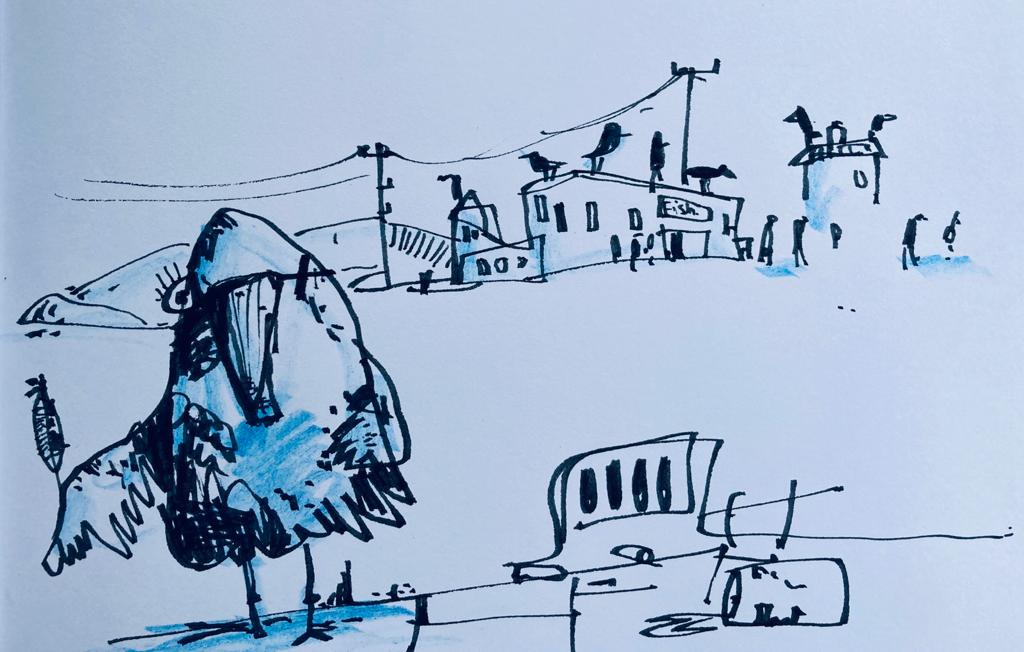
Crows massing on the rooftops of the estate, hunched-shouldered funeral ghouls in their damp satin cloaks, their talons like blind men’s sticks tapping on the slates above us, they natter and shift in the gloom before their sunrise takeoff over the shoreline and into the far-flung hills. One crow stoops on a roof a little apart from the rest, a small collapsed black umbrella, he jerks about on the spot, as if he’s trying to stop himself from inadvertently springing into action and falling off.

It’s said an errant golf ball on the nearby seaside course had hit him. Gouged out his right eye, chipped his beak at its tip, collapsed his wings so he was left unable to fly. Now he hangs about outside the fish and chip shop at night, hopping and sobbing for scraps, the town drunk, the town crier.

His accident may have disabled him but it also left him with unusual powers.  The golfer, whose drive had hit him, searched for the catastrophic missing ball in the rough by the cliffs bordering the seventh hole. As he reached out with his seven-iron to rake back the ball, he followed the momentum of his club and toppled to his death on the rocks fifty metres below. When he was found, a black wing feather protruded from his startled open mouth like an occult message, or a sign-off from the Camorra.

The blow also freed the crow to actually speak. Not in the squawking guttural scratchiness of a Ted Hughes crow, or in the mellifluous sonnet tones of John Gielgud’s narration for that strange nineteen-sixties crow animation for BBC2 – if there ever was such a thing – and if there wasn’t, there should have been – or at least there should be a remake now narrated by Derek Jacobi – ‘oh, sweet indefatigable crow, flap shut your wings and come huddle in the warmth of the beating heart of your wicker-wisp-wound nest’ – no, the crow’s voice resembled, albeit uttering un-authored doggerel, the strangely bird-like strangulated sounds of a grainy tape recording of James Joyce reading: ‘I want battered bastard chips, chip chippered chips, chip chippy chips, and I want them now, now, now!’

As I watched for the sun to rise this morning, I spotted the crow stiffen and fall back, a discarded coalscuttle bouncing along the slates of the roof, then dropping out of sight.  The sun arrived on cue and the other crows flocked into a shambolic dark cloud that grew and filled the sky.

Had the crow been able to, he might have risen to the occasion, recorded the event: ‘as he fell, the sun bled celestial fingers of light through grey dawn clouds, and the black crows rose as a congregation of departing dark-suited mourners, flying out over the fens and the Murrough, out to the hills that lie beyond Newcastle, to the Glen of the Downs, The Sugar Loaf, finding solace in the turbulent expanse of The Irish Sea.’

But no, he was dead and un-mourned, except by me, and those who appreciate a crow that crowed more than the rest.

*Crow was published on Fictive Dream, the illustration is by Jonny Voss

Posted in Uncategorized | Leave a comment

WATER, WATER

HAND ME MY HAND

‘You can pin a maggot on a mackerel but you can’t pin a mackerel on a maggot,’ whispered the featureless child, his unheard words of wisdom floating away on the wind.

There was lot of wind on the Suffolk coast that day and it was busy dragging the kite belonging to the father of the featureless child along the far side of the beach.

‘Feck it, feck it and feck it,’ scalded Dad.

The snake on a rope thought he said ‘fetch it’ but his impulse to slither over and fetch it was curtailed by a sharp yank on the tie-rope around his neck. His trunk slinked and then coiled up into itself; his gasping tongue protruding to fork the passing currents of air.

Amongst the masses of messed up line attached to the kite emerged a giant ugly deep sea fish. It stank and shouted at a woman and a baby ahead of it.

‘Not mackerel, not a maggot, not a monkfish,’ mumbled and murmured the featureless child.

‘Mmmmer mmmmer mmmmer, can’t make any fecking sense of any fecking thing you say, lad,’ blasted Dad.

‘Sssssand shark, it’sssss a sssssand shark,’ hissssssed the snake.

Dad went to have a closer look. The stinking sand shark bit. He came back with the kite but without his hand.

‘That takes the biscuit,’ sobbed Dad.

‘That took your hand,’ corrected the featureless child.

Dad looked at him for a moment. ‘I understood that bit, lad, you’re right. Good to hear you talk normal for a change.’

The snake slithered back with Dad’s hand.

‘Thanks, snake,’ said Dad with a playful yank at his tie-rope. ‘Now let’s go home, your Mum has got some serious sewing to do.’


IT’S OVER

That whole polluted mass thing, sub species of the sea, nets, giant flotsam, carrier bags, batter scraps, its stinking skeleton and head like a pumped up trout, waddled its way over the waves to introduce itself to Mickey Fish junior, the son of famous weather disseminator Mickey Fish senior.

‘Get back to the tidal waters, ye sardine sons of Satan!’ cried Mickey Fish junior.

‘We are harbingers of environmental and maritime catastrophe.’

‘The climate doomsday scenario, eh? That’s the cunning tongue of Papist dogma, and you are the fish spawn of vile Vatican venom. Back to your deep dark waters, I bid ye.’

‘In you we have picked the wrong human to warn mankind.’

‘Take your wicked wilful words and drown them in your long Roman robes of blood and Piscean blubber.’

‘We’ll be off then but don’t say we didn’t warn you.’

‘Hook off, and don’t ye think leaving any of your sick roe or landing any one of your repugnant thought processes over here – not amongst our great united band of brothers, you won’t.  No more, I tell ye. No, more!’

‘Ungrateful or what?’

And the polluted mass thing dragged itself back over the shallows, and, reaching the drop of the sea shelf, sunk itself into the tarry deep chill of ocean and disappeared.

Mickey Fish junior met his father for a mug of tea and fish and chip dinner.

‘The high priest of tricks and tuna came, Da, and tried to say the waters were drying up and going bad.’

‘Eat you cod, Junior, and drop the Paisley talk.  Everything is going to be just fine.’


NIGHT SWIMMING

Each summer’s night Beatrice and Marie Von Sudenfed arrived for a skinny dip (though Beatrice liked to keep her pants on) under the lustrous silky moon. They skipped amongst the pond flowers on the bank that led into the water. The air swooned with perfumed blossom and the light warm scent of the young women’s skin.

Suddenly a puff of pheromone escaped the lively, watery earth like pollen from a flower sac and rose and swirled and blossomed into the form of a proboscis-quiffed teddy-boy flower, his stem straight and firm like iron; his beady eyes fixed on Beatrice. She felt the aroused intent in the air and shied away, whilst Marie Von Sudenfed, the elder and more experienced of the two, reached over to wring his neck.

He ducked down and appeared to evaporate away. But later as the moonlight cracked and seeped amongst the branches of the trees, his fine misty tentacles could be seen caressing over the water as the girls swam out to the nervous centre of the pond.


BARKING TO WOOLWICH, THE RIVER WAY

Big taxi mouth Barney Eggleston got himself and his pooch kicked out of a London cab for mouthing the dirty. Not only that but a big winged tit was dancing on the roof of the cab and taking the St Michael, so he let it have one with a five-note concord straight in the beak: a right bloody mess. In the melee his pooch only went and got himself on the wrong side of the river. Barney was straight on the blower to his missus: ‘Andy, listen up, dog’s bollocks only gone and got himself the wrong side of the river’.

Barking to Woolwich

‘What you on about?’ she screamed.

‘Prince has only gone and got himself -’

‘I heard that, cattle brain, I just don’t know what you’re on about.’

‘Look, Andy, he’s got south side of things and I don’t know how he got there.’

‘Well, you’d better get figuring, that dirty pooch cost a cow’s arse lick.’

He wasn’t sure what Andy meant by this but his brain had bigger things to fry. He tried to reason out things in a thoughtful way: ‘It’s like that story about the fox and the chicken and the eggs and the boat.’

‘What you on about now?’

‘I’m meaning it’s like he’s the chicken and the fox is me, and -’

‘Feck off with all that,’ shouted Andy, throwing her receiver down.

Barney put away his blower and whistled for his pooch to come over. He even tried to entice it with the wave of an Adam Smith. But then he remembered however monetarily inclined his pooch might be, he couldn’t swim a doggie.

‘Stay there, Prince my lad, I’ll come to you.’

But too late: Prince had gone off to use his return ticket on the ferry.

Barney was waist deep in Thames pong when he saw the ferry come towards him and it was then that he remembered that he couldn’t swim either. His phone rung: it was Andy: ‘the fox would eat the chicken, you ponce. But don’t get any fancy pant ideas about cooking up Prince,’ she screamed before a circling swirl of water sucked her voice and Barney down.

And then a curious stillness, save a few bubbles popping up on the water’s surface, and the passing sound of a dog’s howls deep into the heart of the river.


CRAB AND GULL

Fester Crab and Benjamin sparred all summer and autumn, trying to pluck a feather or pierce a shell. One bright December morning they met for a last hurrah before their beach was carried away on winter’s drifting sand.

‘I hold my claws up to you, Benjamin, and offer you the dance of peace.’

Fester danced a circle and Benjamin Seagull watched.

‘Old adversary and now dear friend, you dance well for a crab. But it’s time for me to say my goodbyes and bid you one last farewell.’

Benjamin Seagull flapped his wings and flew into the opulent blue sky.

‘I hadn’t finished my dance. Typical of Benjamin to leave before all was said and done.’

At that moment Fester felt a tiny pain on his left side.

‘Most likely a heart attack’, suggested a medical crab at his funeral. ‘It was probably brought on by a change in the weather.’

‘The cold,’ said Benjamin. ‘Fester never liked the cold.’

In his will Fester left his protective shell to Benjamin, who wore it on his back until it dropped off during a violent storm near Newfoundland.


WATERWORLD


An old lady and an old man sit on an inflatable sofa.

Said it was like 1938 to 1939 all over again.

I know.

Teetering on the brink, dithering in the face of disaster. All too late, nothing to do about it, we were all doomed. Doooomed! No one believed him.

Not now.

Earth heating up, waters rising, washing us away in the swell!

Leave it. Let’s rest a little.

I worked for him after they put him in a nursing home, tight as a tack he was.

Was he?

He was! I put his dentures in a tin and shaved his whiskers with my fingers to save on razors.

Of course you did, makes sense now you say it. Now, are you going to buy me a drink, I’ve come a long way.

I don’t know you, do I?

You do, we talk ever day. My drink? Please?

Another one said Noah’s ark was real, found the planks and everything.

Everything?

Don’t need Noah now, and a boat would be a waste of time. They’re building rockets to Mars: Bezos, Musk, that Branson, they’re all in on it!

In on what?

Selection! The chosen ones, they’ve been selling tickets on rockets to their friends for years. We’ll be left to fend for ourselves.

Branson wouldn’t do that. He’s got a nice smile.

Dinosaur teeth, they all have: Charles, Camilla, Cilla.

Cilla?

Black! Dead Cilla Black! My scrotum is like litmus. All that itching, it senses things, can tell a bad one from a good one, it knew the deluge was afoot.

Rained 400 days so it must have been very itchy.

And 400 nights, sandpaper on nylon sheets. I’ll get you that drink now.

Daft sod, I was teasing you. Where are you going to get me a drink now?

Their sofa wobbles in a swell, the gloop of dark water twisting and spreading under the moonlight.

Could use a cup to scoop it out.

We don’t have a cup. And we can’t drink; it’s contaminated

We’re done for then?

Of course we are.

Can you swim?

Can you?

Used to be able to.

There you are then. Why don’t we hold hands, have a kiss maybe, share some of the old air raid spirit?

My scrotum is telling me this isn’t going to end well

You don’t need your scrotum to tell you that. Now shut up and give me a kiss.

But I don’t know you.

We’ve been married for sixty years you silly old fool, now hold my hands and give me a kiss.

Bert takes Mary’s hands in his, and kisses.

Oh, your lips are dry, my love.

And a wave suddenly moves them from view as a large rocket passes over the moon.


WHAT MARJORIE THINKS IN THE SHOWER


Oh lovely teardrop, will you rain on me?

I’m but a flower under your tree.

Will you quench my heart of its ire?

I’m Marjorie small body, of large desire.


MAN IN SHOWER

Man in pane

Condensation

Man get hot

Palpitation

Man bit stuck

Constipation

Man do fart

Fumigation!


Pictures by Jonny Voss, except Man in Shower which was drawn on a shower pane by Isaac Voss.


A few of the pieces have appeared before on Epoque Press, Litro, Words for the Wild, Fictive Dream and 3:AM Magazine.

Posted in Uncategorized | Leave a comment

WILD CAMPING

In the kind of wild campsite they liked to frequent, toilets were at a premium and not to everyone’s taste. Think basic. Think no flush. Think sawdust and constipation.

Drinking helped relax things but also added to the need to make a visit. Four pints was a typical threshold for the floodgates to open and then visits became increasingly urgent and frequent. But drink also made toilet-goers forget the warning sign at the entrance to the campsite:

‘Beware the giant bearded tree man in the forest who will hold you like a leaf and snap you like a branch.’

‘What a silly sign!’ hadn’t Harriet said, but no one had seen Harriet for days.

Peter Perves needed immediate relief and made his way as quickly as possible across the campsite field to the toilet, rolls of paper falling out of his pockets.

The sky was a dagger moon shrouded by gesticulating clouds and Peter Perves thought if he whistled everything would be okay. It was only when he got to the trees near the toilet that he felt it odd that his whistle was being returned in a loud shrill echo that made his cheeks smart and his skin crawl. He looked into the trees to see where the whistle was coming from and his head was plucked clean from his body. A tiny scream was emitted and repeated.

‘What the fuck was that?’ shouted Marjorie from inside the tent.

‘I didn’t hear anything,’ said Simon.

‘You mean you didn’t want to hear any fucking thing!’ shouted Marjorie.

‘Shush, I can hear something coming closer,’ said Spenser.

‘I can’t hear anything,’ said Simon.

The sound was of ridiculously fast running getting louder and nearer.

Spenser, who had troublesome IBS, farted.

‘I heard that!’ said Simon.

Peter Perves’ head suddenly appeared in the gap of the tent’s entrance.

‘Thanks be to Christ,’ shouted Marjorie. ‘We were beginning to wonder what had happened to you?’

‘I wasn’t wondering,’ started Simon, when Peter Perves’ head dropped and then bounced along the tent floor and onto Spenser’s lap.

‘Spenser shrieked and farted: ‘what on earth do you think you’re doing, Peter Perves?’

‘He’s not trying to do anything,’ shouted Marjorie.  ‘He’s dead!’

‘I can see that,’ said Spenser. ‘But why did he land on my lap?’

‘I’ve had enough of this nonsense,’ said Simon, and he snatched Peter Perves’ head from Spenser’s lap and kicked it out of the tent.

Spenser watched Peter Perves’ head land in the field outside the tent, and then he farted.

‘Stupid fucking thing to do!’ shouted Marjorie.

‘I can’t help having IBS,’ said Spenser.

‘No, I mean it was a stupid fucking thing for Simon to kick Peter Perves’ head out of the tent,’ shouted Marjorie.

Marjorie was right, it was a stupid fucking thing to kick Peter Perves’ head out of the tent, and the next day the friends’ body parts, including Spenser’s troubled bottom, were hanging from the branches of a giant tree.

‘Should have read the sign!’ Marjorie might have shouted if she still had a body, or if she was a kind of ghost that actually spoke.

But she wasn’t any kind of ghost: ‘Ghost stuff’s all bloody nonsense,’ Marjorie had often shouted, though Peter Perves and Spenser had always believed in such things.

Years later, as trees swayed in the surrounding forest, local boys played on a football field that had once been part of a campsite. The whistle blew for a penalty, and a small boy swore that the ball winked at him as he kicked it towards the goal.

*

Wild Camping appeared in Sonder Magazine in September 2022 https://sonderlit.com/product/issue-vi-odd/

The picture is by Jonny Voss

Posted in Uncategorized | Leave a comment

PLEASE ALLOW ME TO INTRODUCE MYSELF

Would you look at the house? Even from the agent pictures, it reeks damp and grubbiness: the green felt pool of carpet, the dirt tan of nicotine on the walls, the lopsided mock chandelier in the lounge. Here is a house that someone has died unhappily in: neglected, housebound and probably too weak to eat or cry out for help.

For the love of God, shut up you miserable bastard. It’s a house, and you have no right to pin any of your maudlin nonsense onto it. Leave misery well alone: a lick of paint and it’ll be dandy.

Dandy? The house is a mausoleum and if you so much as consider viewing it, then we’re both surely dead.

Now there’s a good reason for me to ring the agent first thing tomorrow.

And so it was that Eamonn and Sue Leonard found themselves walking up the pathway to the house the next morning.

I told you. I can smell destitution and decay from here.

All I can smell is you. Now shush, here comes your man.

Mr. and Mrs. Leonard, as I live and breathe, is it you I see standing before me?

It is, and you know it is because we spoke on the phone only an hour ago.

I’m sorry, Mr. Coulson, my husband has a rare and aggressive form of dementia.

Isn’t that the worst kind, Mrs. Leonard? Well, I for one hope he makes a speedy recovery. But before we make our way in, I must tell you that you will not be the first to see it.

And we won’t be the last?

Ah, Mr. Leonard, please, I’m merely trying to say that there has been some interest already.

Well say it then, don’t try to say it.

Ignore him, Mr. Coulson, it’s just his way but we both know I’ll get my way in the end.

And Mrs. Leonard did get her way, and in a more meaningful way so did I. Please allow me to introduce myself – no fanfare needed, a funeral procession will suffice: my rear extension is wide, my mouth cavernous and my appetite insatiable, for I am ‘The House’.

‘Reeked of damp’, of unhappy deaths and decay observed the astute Mr. Leonard. Well, his death put an end to anymore of that kind of talk: a celebration of sorts, a climax reached with glass confetti raining down from the ceiling – the chandelier (he should have left it lopsided) pinning him like a stake through his head and onto the floor.

Where was the wife I hear you ask, his guide to direct him, to nag a certain degree of safety into his stubborn (as yet un-fractured) skull? Unlikely, she’d have made an appearance for he’d already buried her the day before under a cold clod of earth in the woefully unkempt garden; murdered her with a degree of irritation and a smidgen of mercy, for saying for the millionth time that the house was whispering to her at night to take off her clothes and run into the dark screaming like a banshee (as she had done on countless occasions before).

I look upon it as marriage guidance, as benign intervention made on behalf of poor Mrs. Leonard. A conduit of her desire, she asked and he did as was requested: ‘For the love of God, kill me, Eamonn, put me out of my misery, I can’t breathe another day in this wretched house.’ Thwack! And her wish was granted.

And Mr. Coulson? He’s complicit with me, the sick bastard. A diary full of couples with the promise of a commission and the ghoul is happy. But if he should ever falter in his resolve he will find his way into a bricked up wall along with the other agents.

My desire is only for completion. And, as I speak, here stands another couple at my front door: a kitchen’s unearthed wire impatiently breaking free at my skirting, the foundations of my soul loosened for a tremor that will surely come, those fragile roof slates edged just a little looser for that pick of wind, as – now, what‘s her name?

‘I love it already Jack.

‘I knew you would, Lilian.’

Ah, yes, as poor little Lilian steps back from the front door and looks up.

‘Cut her in two. Never seen the like of it,’ the startled policeman will soon be quoted as saying in the local paper.

In a picture accompanying the article, I’ll be smiling my breezy front door smile, a letterbox hint of tongue, the bright bulbs from the upstairs windows indicating activity: lights on, ready for business: let them in and keep them coming, I have rooms to occupy, and mouths to feed!

Oh, and what of Mr. Jack? Well, if you will go into a kitchen screaming like a madman, then you are unlikely to notice the wire snaking around your feet, carrying enough charge to arouse the departed and electrify the living.

  • The illustration is by Jonny Voss, and the story appeared as ‘The House’ in February’s flash fiction month on Fictive Dream
Posted in Uncategorized | Leave a comment

VOICE OFF

VOICE OFF

He is his own shadow man, embarrassed to stand on the ground and make an imprint. When he walks for the last time into the television studio his body is a reluctant guest, shirking from its duty to move him, it hunches and sidles along. The features on his face aren’t quite defined on the screen, the thin crease of an apologetic smile barely visible: ‘I’m boring but it’s okay: I know it’s not me you want, it’s them, the voices you’ve all come for . . .’ 

The voices, faces and gestures belong to others, to the stars and their characteristics he’s absorbed and mimicked all through his life. Mum spotted them first and had loved them. She wanted him to spread the joy: ‘Oh, do George Formby for Mrs Rosen, please!’

He didn’t want to.

‘Cleaning Windows? Or Elvis, he does a wonderful Elvis, Doreen, almost better than the real thing!’

And so he let out a little of his Elvis: a sudden hip wiggle, shoulder turn and lip quiver: ‘ah, ah, ah! Ah, ah, ah! Oh yeah!’

Mum and Mrs Rosen were off their chairs, clapping.

‘He was even better yesterday, Doreen.’

‘It’s amazing, Brenda, he’s normally so shy.’

‘Not when he’s doing the voices!’


At his peak he was Liberace, Frank Spencer, Bruce Forsyth, Jeremy Thorpe (difficult that one), Danny La Rue, Tommy Cooper, Brian Clough and Hudson, the butler from Upstairs Downstairs. Las Vegas had Sinatra ‘The Voice’, and each summer he headlined Blackpool as ‘The Voices’. But when Thatcher won the election in 1979, it spelled the beginning of the end: ‘I’m not doing drag, I’m not a pantomime dame.’

‘You do La Rue,’ said Sid, his agent.

‘That’s me doing a pantomime dame, not me pretending to be a woman and looking and sounding like a pantomime dame.’

‘It’s a thin line, surely’

‘And not one I wish to cross.’

‘The lady’s not for turning?’

‘Bugger off, Sid.’


His showbiz glory days, along with several marriages, were well behind him when salacious stories about nineteen-seventies celebrities began to surface, bringing with them You Tube clips of his impersonations of the diabolical quartet:  Saville, Glitter, Harris and Hall. His fan club gets an unexpected call: ‘Get your Dad to ring me if he’s sober, there’s an exciting offer on the table he might be interested in!’

When they met again, Sid had aged as much as he had, but he’d kept up with things and still had an eye for a deal: ‘they want you to share some voices with the new voice man, Ben Gould.  You’ve heard of him, right? Ben Gould has edge, he’s down with the youth market!’

‘I don’t do edge, Sid, and I don’t go down for anyone, you know that.’

‘Saucy, I like it: your new style? Just remember one thing, my friend, you didn’t do Thatcher and look where that got you. So, are you interested or not?’

‘I’m interested but I’ve lost faith. The problem isn’t the voices, it’s the scripts mimics have to use: we can’t help but be a pale imitation of the real thing. And if I don’t do voices, say ‘this is me’ and start to sing, people don’t like it.’

‘You should never spoken as yourself or sang, it took the energy out of things.’

‘Now you tell me.’

‘This is your chance, don’t be stupid.’

‘You sound like Captain Mainwaring: “Stupid boy”. “I’m not a stupid boy, tell him uncle Arthur.” “Oh dear, you see, Captain Mainwaring, I’m not at all sure young Pike can handle being spoken to like that.”  “Captain Mainwaring, there’s a black cloud hovering yonder, and we’re all doomed. Doomed!” “I’ll sort it, Captain Mainwaring, when those fuzzy wuzzies came at me with their whirling dervishes, I fixed my bayonet and –“ “Sorry to interrupt, Jones but I need the, mmm, mmm, rather quickly.”  Six voices in one, there you go!’

‘Very impressive, but you’ll have to find some new ones, it’s not 1975. I’ve booked you a month of Saga cruises to Ostend to warm you up.’

‘Death by ferry! Do I have a choice?’

‘Does the Pope wear Speedos?’


‘Dad! Pack three jumpers, it’ll be cold on deck. And don’t be nervous, there’s been more interest in the fan club: three messages yesterday, two of them positive. Get through the ferry gigs and the show with Ben Gould will break you again.’

‘I hope you mean ‘break’ in a good way, Suzie.  Thing is I’ve watched Ben Gould and I just don’t get it. He announces who he’s doing before each voice, then purposely does someone else and then comments on the mistake.’

‘It’s deconstruction, Dad, it’s popular now.’

‘But it’s not funny.’

‘It’s clever, people like clever.’

‘I can’t tell whether it’s clever or stupid. I’ve never liked people talking about what they’re doing, magicians giving away their tricks. Just do the act, get on, get off.’

‘It’s okay, Dad, your old school, they’ll love you on the “Ostend Pride”.’

‘I think you’ll find it’s “Pride of Ostend”, Mrs Thatcher’:  There, Robin Day, one of my best. Will I have to explain that too?’

‘No, not for the Saga crowd, they’ll know who Robin Day is. Just be positive.’

He started to sing: ‘”Always look on the bright side of life.” I think I’ll end the act with it.‘

‘Dad, not that kind of positive: don’t sing, don’t drink, and you’ll be fine.’


In the good days he drove to Southampton docks in a Silver Rolls he’d brought from Engelbert Humperdinck. He, Suzie and her Mum, his first wife, always went First Class on the QE2.

He met Liz Taylor and Richard Burton at the Dorchester. Liz called him over to their table: ‘Richard and I loved you on TV last night; you were so goddamn funny! Your Liberace, what a hoot! He talks just like that, you know, and you got him, you got him!’

‘I’m a fan of both of yours, Cleopatra and VIP’s are two of my favourite –‘

‘Yeah, yeah. Now a little bird tells me you sometimes do Richard reading Dylan Thomas. Will you do it for us, please?’

‘Are you sure?’

‘Yes, but it better be good or we’ll have you thrown out.’

‘To begin at the beginning: it is spring, moonless night in the small town, starless and bible-black –‘

‘Jesus, Richard, he’s got you, he’s got you!’

‘Elizabeth, keep the noise down, you sound like a braying donkey.’

‘Stop! Stop! It’s uncanny; he’s doing your George talking to my Martha. Oh, Richard, this is just brilliant!’

The real Richard held up a glass filled with Jonny Walker Black. ‘Yours, I think,’ he said, handing it over to him.

He kept up the voices for hours. They were spellbound and by the end of the night two bottles had been emptied.

He left as Dean Martin with a stagey, drunken flourish and bow. He knew not to sing, just whisper ‘That’s amore.’

In the taxi home he reached into his jacket pocket and found a white napkin with ‘thank you’ written in red lipstick on it. Wrapped inside were a pair of diamond cufflinks. It had been his finest hour.


The cabaret on the ferry went better than he’d thought. His Sylvester Stallone even got a laugh but he was out of practice and it made his jaw hurt – ‘you do Stallone by pretending your tongue is swollen and your chin is frozen. Too little and you just sound drunk; too much and you sound like you’ve had a stroke’ he’d once explained to Michael Parkinson on TV but Parkinson hadn’t got it. His Al Pacino was wildly unrecognisable so he reverted to an old favourite: ‘Slack Alice said the exit was over there. Oh, shut that door!’ and that got a big belly laugh.

He’d always stayed clear of doing impressions of black celebrities apart from a blacked-up Al Jolson, which had been wrong for all sorts of reasons. It didn’t feel right to attempt Obama but his Trevor McDonald interviewing prisoners on Indiana Death Row was an unexpected success: ‘Because of the terrible nature of your crimes, you are hated by society and the other inmates. You will never see your wife or children again. You will either be killed by lethal injection or spend the rest of your life in solitary confinement. Do you ever feel sad?’

‘No more McDonald, leave Gould to do new voices and be the daring one,’ advised Sid on his return from Ostend.

‘You wanted edge, new voices!’

‘The brief has changed, he wants the old voices: Forsyth, Cooper, Emu.’

‘I thought Gould was “down with the youth”.’

‘Have you seen “The Trip”’?’

‘Too much Connery and I didn’t like it.’

‘It won’t be Capri or anything, it’ll be one hour in a studio with a live audience and he wants you chatting naturally with him, slipping in voices like Rob and Steve do. He’ll handle the new voices, the risky or ironic ones, you’ll do the old ones.’

‘I could do Pacino –’

Sid raised his eyebrows.

‘You do Forsyth, Cooper, but ditch Emu if you like. He just wants you doing your voices and he’ll come back at you with his. He’s a fan, he’s not out to destroy you.’

‘When do I get to see the script?’

‘There isn’t one, there’s a through line, a story arc. The door is open, you just have to go through it.’

‘What’s this disaster going to be called?’

‘Voice off.’


‘Chatting naturally’ was the problem.’ It would mean he’d have to be himself when not doing the voices. Over the next weeks he talked to Gould twice on the phone but they never met. Gould wanted to keep it real, sparky, spontaneous but told him he’d grown up watching his programmes and loved them still.

The programme was billed as two heavyweight champions from different eras meeting for the first time in the ring: the old pro coming out of retirement to take on the new pretender.

In his dressing room before going on, he thinks of “Raging Bull” with Robert De Niro as a washed up Jake La Motta rehearsing his tired nightclub routine: Marlon Brando in “On the Waterfront”: “I could have been somebody – “

He wonders about rebelling and slipping the line in, him doing De Niro doing La Motta doing Brando.

Walking out onto the studio stage to meet Gould, he remembers what Suzie had said. Too late to heed her advice not to drink: he moves uncertainly, as if his legs don’t quite belong. But when he senses the audience close, his indistinct apologetic features take form and he adopts a well-known pose: knee up, bent elbow, and right fist to the forehead. A quick head tilt, slight mince and run, and he’s off: ‘Nice to see you, to see you nice!’

Gould lies in wait, and then spins his chair round to greet him, chomping on a cigar, revealing a long white wig and familiar gold tracksuit: ‘Now then, now then, what have we here?’

When he hears the devil’s voice, Forsyth suddenly departs and he speaks as himself:  ‘Sorry, I’m not going there!’

Gould is flummoxed, and continues as Saville: ‘Now young man, why don’t you sit here?’

‘I’m seventy-bloody-five and I’m not sitting anywhere near you. Now just fuck off.’

The audience murmur, and a few clap.

‘Ooh, lively. Now then, now then.’

‘And your impression is rubbish. Or is that the point?’

 Some in the audience laugh, which spreads to others, and he unclips his microphone and walks off the stage.

For a moment Gould looks lost, even hurt, but then turns to the audience with a long leer. Nervous audience titters respond, and a single long ‘boo’.

In the wings, Sid is beside himself: ‘what do you think you’re doing? It’s an hour special!’

‘Nothing special, Sid.’

‘Get back out there, you drunk!’

‘Cheers!’

Suzie is crying and holds out her arms to greet him: ‘Dad, I’m so proud of you!’

‘Why? I’ve just thrown away your inheritance.’

‘You were yourself!’

‘I did it ‘My Way’?’

‘Ha, if you break into Sinatra now, I’ll leave you here.’

‘Don’t worry, I never did him very well anyway.’


*

An early version of this story was published in Lakeview International Journal of the Arts. Vol4, No.2

Posted in Uncategorized | Leave a comment

THE SPOT

THE SPOT

Richard and Sue have a friend called Roger. He was originally her friend from university and was best man at their wedding.

Twenty years later Roger has got himself in an undisclosed sticky situation and has asked to come and stay in their one bed flat in Tufnell Green. Three consecutive Tuesday nights are all he ‘needs’. Tonight is the first.

WEEK ONE

‘Put your bags out of the way in our room, Roger,’ says Richard. ‘And I’ll fix you a long one, you look like you need it.’

‘Not too weak,’ shouts Roger from the bedroom.

Richard is waiting with a glass when Roger returns to the lounge.

‘Thanks, Richard, that looks nice and strong to me!’

They clink glasses.

‘Still the same lumpy bed sofa, I’m afraid,’ says Richard.

Roger laughs. ‘So, where’s m’lady?’

‘Getting us a takeaway.’

‘From Khan’s?’

‘Naturally.’

And they clink their glasses again.

Sue arrives looking windswept around the front door with two brown paper takeaway bags.

‘Here she is, here she is,’ says Roger bounding towards her to give her a hug. As he holds her, Richard rescues the bags.

‘I’ll sort these.’

He glances back at them as he pops into the kitchen and Roger is still holding on.

‘You’ll have to let go of my wife, Roger, or she’ll stab you!’

‘What are you talking about, Richard?’ she says.

‘Food, my wife needs her food and nothing should get in her way!’

‘Oh, Sue, you’re not pregnant, are you?’ asks Roger, letting her go.

‘Huh? Oh God, no,’ she says, laughing.

‘Wine or beer?’ asks Richard.      ‘Wine!’ they shout together.

‘Wine, it is,’ he says.

Various whiskies and two bottles of wine later, and they sit at the table in the lounge amongst the debris of empty takeaway cartons and dirty plates.

‘Shall I?’ asks Richard holding up a third bottle.

‘No, I’ve had enough. We’ve had enough,’ says Sue.

Two’s company, three’s a crowd!’ says Roger, laughing.

‘I’ll open it then,’ says Richard, laughing too.

‘No, don’t!’ says Sue firmly.

But he does open it. She puts her hand over her glass when he comes to pour, and he carries on pouring over her hand.

‘For fuck’s sake! Why did you do that?’

‘I thought you were being a prude.’

‘A prude? No, I’ve got work tomorrow and I don’t want to go in with a hangover.’

Roger returns with a kitchen roll from the kitchen. He tears off a sheet for Sue and uses a few other sheets to clean the table. ‘Why don’t you two lovebirds go to bed and make up? I’ll sort out the mess. And, anyway, Bertha is waiting for me,’ he says with a wink, indicating the sofa bed in the corner of the room.

‘Bertha? I’ve never heard it called that before,’ says Richard.

‘Before you, Richard! Sue and I called her Bertha when we dragged her into our last student house, didn’t we, Sue?’

‘We did. A berth in a storm,’ she replies.

‘Not a big girl with big cushions?’ asks Richard.

‘Get to bed, Benny Hill,’ says Roger.

Richard drains his full glass and walks off, waving back over his shoulder.

‘There is a quilt and some bedding in the bag,’ says Sue.’ ‘Do you need a hand putting Bertha down?’

‘No, no, ooh what a carry on.’

‘Is everything okay, Roger?’

‘God, yes. I could ask you the same.’

‘Well, don’t.’

They hug.

‘Watch the knife!’ shouts Richard from the bedroom.

The light is on as Richard watches Sue get into bed.

‘Our friend, why’s he here?’

She doesn’t reply.

‘And what is this mysterious ‘sticky situation’?’

‘Tricky!’

‘What?’

‘He said ‘tricky’, not ‘sticky’.’

‘Whatever.’

‘Yes, whatever. Now, can we turn the light off?’

‘What’s the magic word?’

‘Okay, I’ll do it!’ she says, getting out of bed.

He rushes and beats her to it.

Standing together in darkness by the switch he tries to kiss her but she ducks and climbs back into bed.

As Sue sleeps, Richard lies awake and remembers meeting Roger the first time. Sue was an intern and he’d just asked her out.

‘Do you mind if I bring a friend?’ she said. ‘He’s very nice, but you’ve got nothing to worry about.’

‘I’m not worr−’ but before he could finish, she pulled his head towards her and kissed him.

Everything neatly tied up there and then: her attraction for him and her lack of attraction for her friend. He remembers his handshake when they first met: soft and wet like lettuce.

It’s morning and Roger and Sue have already left. Last night’s mess is cleared. The breakfast plates and mugs are in the dishwasher and Roger has put the bedding back in the bags and turned the sofa bed back into a sofa. ‘Good man,’ thinks Richard.

In the middle of the sofa seat is a large damp spot. Richard bends down to have a closer look and puts his finger tentatively on the spot. It’s cold and sticky. He recoils, his brain notching up a gear: ‘it couldn’t be? And, anyway, if it was he’d surely try and hide it, and I’m not checking, sniffing’. But he does sniff and closes his eyes when he does, he’s not sure why. ‘Fuck!’ Fucking hell!’ He thinks about checking the bedding in the bag. It feels too much, sordid, but also straightforwardly forensic, a conclusive step down the line to confirming something he’s not sure he wants to confirm right now. But against this instinct, a stronger impulse makes him pull the sheet from the bag. The same spot is on the sheet and when he places the sheet on the sofa the spots merge in a perfect match.

The sheet, the quilt cover, the pillowcase are thrown into the washing machine. He thinks about how to clean the sofa seat and instead flips it over to reveal its dry side, and goes to have a shower.

WEEK TWO

‘Hello, anyone there?’ Roger shouts through the letterbox.

‘Just wait a minute!’

‘I’ll huff and I’ll puff.’

Richard opens the door in a dressing gown.

‘Gosh, you’ve gone all Gloria Swanson on me.

‘What?’

‘The darkened room, the curtains shutting out the day, and the silk dressing gown –

you must tell me where you got it.’

‘Sue bought it for me.’

‘Your wife has such good taste.’

‘Make yourself at home, I’m going to get changed.’

‘Where is Sue anyway? Getting us another takeaway?’

‘Ask her yourself when she gets in.’

Richard closes the bedroom door. Roger flicks through the cd’s in the lounge and puts on David Sylvian’s ‘Brilliant Trees’. He takes a bottle of red from his bag and uncorks it. He fills three glasses and takes one of them to sit on Bertha.

Sue arrives: ‘Oh, Roger, I haven’t heard that album for ages. His voice still sounds amazing.’

Roger gets up, hands her a glass and pecks her on the cheek.

‘”Pretty boy handsome”, you called him.’           

‘No, that was you Sue.’

‘Roger, it was you!’

Roger puts his arms in the air: ‘Okay, guilty as charged, it was me.’‘

‘Where‘s Dicky boy?’

‘Being moody and magnificent in the bedroom.’

‘What’s new?’

‘You tell me, Sue.’

‘This is lovely wine. Where did you get it?’

‘Changing the subject or really interested in my wine selection?’

‘Never you mind. Now, what has Richard cooked for us?’

‘Nothing I’m afraid,’ Richard says returning from the bedroom. ‘I’ve had a really busy day.’

‘Oh, okay,’ says Sue.

‘Notice the rising inflection, the stealthy lightness, the subtle but steely surprise in Sue’s voice?’

‘Don’t start, Richard.’

‘Sue finds it hard to imagine me being busy all day.’

‘Well, I don’t actually.’

‘Now, now, ladies, we all know there are shopping channels to gaze at on the telly, funny cat pictures and porn sites to surf on the net.’

‘Not my style, Roger, but very funny of you to suggest that’s how I spend my day.’

‘God, is it your time of the month or something?’ 

‘Yes, shut up, Richard, and have a drink,’ says Sue.

‘Okay, ’ and he drains his glass in one.

‘Now, that’s what I call wine appreciation,’ says Roger.

‘I’ll go and get us something from Khan’s. Leave you two to wallow in your student music.’

‘Can you make sure they put in the chutneys this time?’

‘Will do, my dearest.’

‘And get some more wine, two at least!’ shouts Roger as Richard closes the front door. ‘Now, where were we?’ he says turning to Sue.

Richard takes his time. He has two pints in Boadicea before going to Khan’s, another in Khan’s whilst he waits, and a Guinness and a chaser in the Boston Arms on the way home.

Grace Jones La Vie En Rose is on very loud in the flat when he gets back.

‘The wanderer returns,’ says Roger, now sporting Richard’s dressing gown.

Richard instinctively thinks of the spot; sheerness of material, closeness, the question of underpants: ‘You’re clothed under there?’

‘Strange question, boxers, vest and more besides.’

‘Oh, Jesus, I’m tired,’ says Richard.

‘That busy day you had,’ says Sue coming in, also in a dressing gown.

‘What’s going on?’

‘You took so long that we had showers, finished the red wine, and even had time for a chat and a bop. Now where’s the curry?’

‘Oh, shit, I left it in the Boston.’

‘The wine?’

‘I forgot, sorry.’

‘You are kidding, right?’ says Sue. ‘Go back and get them.’

‘Oh, leave him alone, Sue, you’ve got bread and cheese, and I spotted a lovely litre bottle of vodka in the freezer.’

‘You’ve been in our freezer?’ says Richard.

‘Not in it, no. But I had a peep, didn’t realise it was out of bounds,’

‘It isn’t, Roger, just ignore my husband, he’s having some kind of breakdown. Either that or he’s pissed. Which is it, Richard?’

‘A breakdown. I’m off to bed. Behave yourselves, turn out the lights after you, and try not wet the bed, Roger.’

‘What did he say?’

‘It’s Dick’s attempt at humour, Roger.’

‘I’ve left a box of tissues by Bertha or you can grab some toilet roll from the bathroom. You know where it is, out of this door and it’s the door opposite the matrimonial bedroom. Well, the only bedroom. Can’t miss it really, unless you use the other door: for the witch’s broom cupboard.’

‘Fuck off, Richard, you’re being obnoxious,’ says Sue.

‘I am, yes. Sorry. I will fuck off,’ and he slams the door after him.

In bed, Richard can hear the dull indistinct murmur of them talking, Roger’s tenor hum a consistent undertow to Sue’s voice, which becomes shriller the more she drinks. As night wears on, the laughter is more hysterical and frequent, knifing him with each spike, but eventually he falls asleep. When Sue finally climbs into bed she tries to wake him. He pretends to be in an immovable coma as she slurs ‘arsehole’, the sweaty acidic vapour of ethanol from her lips making him wince.

In the morning, Sue is unable to go to work and when Richard gets up, Roger has already gone. A bigger damp spot waits on Bertha’s seat.

‘Fuck!’ screams Richard as soon as he sees it.

Sue stirs and rolls in her bed, her senses moronically mixing in a swell, her brain like quicksand.

‘Our friend has wet the sofa,’ says Richard now standing at the end of Sue’s bed. ‘Again!’

Sue moans.

‘I’m not talking about spraying toilet seats. Roger is a sexual incontinent and he doesn’t clear up after himself.’

Sue surfaces: ‘What are you talking about?’

‘Come and look for yourself.’

‘No! Tell me what you’re talking about.’

‘Roger has been getting his kicks out on our sofa.’

‘What?’

‘Getting his kicks, probably by imagining you, then spurting all over the place. And not clearing up!’

‘Have you gone mad?’

‘Like a rutting dog pissing all over the place and leaving his mark: Roger has always been territorial around you.’

‘Don’t be ridiculous, Richard. Have you been at the Fabreze again?’

‘He’s not staying another night. I’m not having a man in our flat beating away like a gibbon over my wife and then not even having the courtesy to clear it up.‘

Sue laughs. ‘Which is worse, the wanking or not clearing up?’       

‘Shut up, Sue. It’s not funny.’

Sue puts on her dressing gown. ‘Okay, show me.’

‘It’s not sperm,’ she says, on seeing the spot.

‘Feel it.’

‘God!’

‘Feel it.’

She feels it.

‘It’s sticky and wet, I grant you. But it’s not sperm.’

‘Smell it.’

‘Richard!’

She smells it.

‘Not pleasant, but not sperm.’

‘Does all sperm smell the same? Taste the same?’

‘I don’t know.’

‘Is Roger’s different from mine, for example?’

‘God, you are a complete dick, aren’t you?’

‘Not complete.’

‘You said it.’

‘Roger stained the sofa last week too. I didn’t tell you, I just turned the seat cover over to hide it.’

‘Very gallant of you.’

‘I wasn’t expecting him to do it again.’

‘No, but maybe not very hygienic just covering it up.’

‘I didn’t want to deal with it, clean it.’

‘No? But I bet you thought about it.’

‘What’s that supposed to mean? I didn’t know how exactly to clean it and I didn’t want to either.’

Nocturnal emissions, my mother used to call my brother’s nightly performances,’ she says, laughing.

‘I’m glad you think it’s funny.’

‘I don’t, I think you’re funny. Your whole attitude to it is funny: funny peculiar and funny ha ha.’

‘What shall we do?’

‘To clean it? It’s not rocket science. Strip off the cover and put it in the washing machine, I’m going back to bed.’

‘It doesn’t strip off. The cover doesn’t strip off.’

‘Shame. Well, good luck, I’m off to bed anyway.’

‘What shall we do about Roger?’

‘You decide.’

‘Why should I decide?’

‘Because this is your thing; I’ve told you I don’t think it’s sperm. You’re the one insisting.’

‘What if it is?’

‘Then Roger has been pleasuring himself whilst thinking about someone. And I know that someone isn’t me.’

‘Well, who is it then?’

‘Do I really have to spell it out, Richard?’

‘What? No, don’t be ridiculous.’

‘It’s me being ridiculous now, is it? Think about it for a while. I’m off to bed to kill my hangover and I’d prefer it if you left me alone.’

Sue shuts the door. Richard is left staring at Bertha, his brain beginning to spark, heat rising from his chest and into his cheeks.

WEEK THREE

Sue is going to be late. Richard is cooking a meal laden with chilli and basil; Roger doesn’t like chilli or basil.

The doorbell rings.

‘Something smells volcanic,’ says Roger.

‘Hope it’s not too hot for you.’

‘Oh, I’m okay with hot food. Okay with basil too these days I’m glad to say.’ Roger looks round the room. ‘Where’s Bertha?’ he asks.

‘We binned her.’

‘Poor old Bertha, well, she had seen better days.’

‘And lots of action, eh?’

‘Do you mind if I have a shower?’

‘Please yourself,’ and then softly under his breath, ‘you normally do.’

‘What did you say?’

Roger returns after half an hour to find Richard pumping up an airbed.

‘Looks interesting, I never knew you’d taken up pumping.’

‘Never could have imagined it, eh? And why do you sound like a poor man’s Larry Grayson all of a sudden?’

‘I’ve found my inner −’

 ‘Tyre?’

‘Tickle stick.’

‘Ken Dodd, very 70s!’

‘And Larry Grayson isn’t? The new bed: is it rubber? It smells disgusting.’

‘Good for spillages and whatnots.’

‘Whatnots, what a lovely phrase, I haven’t heard it since scout camp.’

‘Camp is the word. Something you’re not telling us, Roger?’

‘Us?’

‘Yes, us.’

‘Enough Tom and Jerry, let’s cut to the chase, Dick my boy.’

‘I’m pissed off that you’ve been wanking all over our sofa imagining God knows what and then not clearing up after you.’

‘Ah, that! I’m insulted you think I wouldn’t clean ‘that’ up . . . I have a condition, a serious but curable condition. I’ve been going to the Royal Free to see a specialist and to have my post-op dressings and apparatus changed.’

‘Apparatus?’

‘Don’t ask. I’ll be okay.’

‘And the mess?’ asks Richard warily.

‘Gel, a silicone wound gel. I should have cleaned it I know but I was afraid to make it worse.’

‘You could have tried or said something, at least.’

‘I’m a lazy coward and I didn’t want to make either of you worry.’

‘Well, you did make us worry.’

‘And fired your imagination, it seems. Have you shared your masturbatory theories with Sue?’

‘She thought I was being ridiculous.’

‘Good old Sue.’

‘It feels silly now, getting rid of Bertha and everything.’

‘You needed to get rid of her.’

‘A glass of wine?’

‘Do I ever say no?’

‘Okay with your condition?’

‘Positively beneficial to my condition.’

The front door opens.

‘What have you two been getting up to?’ Sue asks.

After dinner, the three friends sit on the remaining sofa facing the slowly collapsing airbed.

‘I can sleep on the floor.’

‘Or share our bed?’ says Sue, giggling.

‘As long as I wear a wetsuit, eh, Richard? Or maybe that would look too much like bondage gear?’

‘Richard likes bondage gear, he made me wear a leather catsuit and cat mask on our honeymoon.’

‘Very feline of you, Richard,’ says Roger.

Richard looks at him as the last of the air escapes from the bed and wonders if he’d been lying about his condition. Somehow it doesn’t seem to matter anymore. Roger is laughing and his features look red and coarse as if his face has been burnt by something. Richard wants to cool the heat by running his fingers down his cheeks but realises his hands are hot too. ‘It must be the chilli’, he thinks, and gets up to open another bottle of wine.

*The Spot was recently published by Bandit Fiction https://banditfiction.com/2021/11/01/the-spot-by-alan-mccormick/

Posted in Uncategorized | Leave a comment

STORYTELLER

When the first bomb went off we thought it was masonry falling from a building site. The second blast smashed windows in our lab and a few of my colleagues were cut by flying glass. I checked they were okay, and when I was satisfied the wounds were superficial, I took my medicine bag and went outside to investigate. It was carnage. An elderly man was lying by the side of the road with half his face missing.

Which side?

The right side I think.

I checked for a pulse on his neck, and started pumping his chest.

I was embarrassed when the papers – The Evening Standard and The Daily Mail – called me a heroine. ‘A brave and beautiful Aussie medic was first on the scene’ added some jerk on The Sun. Yeah, right. Next they’ll want me to pose in a white bikini with a stethoscope dangling between my breasts.

At the time I was interviewed on a live broadcast for Sky News. I tried not to cry, and told the reporter exactly what I saw. I mentioned the dark-skinned man running away from the bombed bus.

An old school friend from Sydney saw me on satellite TV and emailed:

‘Just like you, Katie – you’re always where it’s at – really proud of you, girl. I’ve mailed all our schoolmates to look out for you. Take care and write us all about it, it’s been too long. Suzie xxx.’

I remember going to watch INXS. I got Michael Huchence’s autograph and Suzie was really jealous.

‘Did he say anything to you, Katie?’ she asked like a melon.

‘Yeah, he took my phone number and everything.’

‘Bet he don’t ring you, though.’

‘Suzie, I don’t care if he does or don’t; it’s not the point.’

She looked puzzled for a moment, and then said, ‘yeah, right.’

The Mail on Sunday came looking for me a week later to do an in depth interview. Too many questions and I didn’t like them digging into my past. I stopped the interview half way through, even though they offered me lots of money. They had wanted a picture of me looking haunted standing by a London bus.

‘Could you wear your white coat?’

‘I’m not a doctor.’

‘But you treated all those people and saved that man’s life.’

‘I used to be a doctor; I’m a medical lab researcher now.’

‘What are you researching?’

Later, they tried to ask me about my family.

‘Any other medics in your family?’

‘What’s that got to do with anything?’

The journalist changed tack. I noticed the steel sharpen in his eyes; like a snake eyeing its prey.

‘How close were you to the Arab bomber?’ he asked.

I didn’t reply.

‘This close?’ he said, gesturing to the photographer who was standing about fifty yards away. ‘Or this close?’ he said pointing to himself, a spit away from my face.

‘I need to get back to work now.’

‘Yes, but couldn’t you stay and answer a few more questions?’

‘I have to get back’, I replied.

‘Important work, I understand,’ he said.

I’d recognised him from the beginning, now he was just confirming it for all to see: ‘Talk with the devil,’ my father used to say, ‘and you’ll grow a spiky tail and start speaking in tongues.’

When I was small, no matter how hard I tried – and I did try – my school reports were never enough to satisfy my father. When I was kept back for detention after failing my biology test paper for the second time, dad was waiting at the front door. He led me into his study and told me to place my hands palms up on his desk.

With each smack of the ruler, he told me that I wasn’t to disappoint him anymore; I was to be his ‘clever Katherine’.

So, that’s what I became. It wasn’t too hard to change the marks in my reports; the trick was to keep him and mum away from meeting my teachers on open day. The first time was pure luck. My appendix ruptured and I was rushed to hospital, which brought them close so I could keep an eye on them. The second time, I fell off my bicycle and into the path of our neighbour’s car. I wasn’t really badly hurt; just enough to keep them indoors. Then they had Anthony, their ‘miracle’ son – ‘we weren’t planning for one, he just arrived; how happy we are though’ – their immaculate misconception. But Anthony’s arrival proved useful, serving to drain their energy and interest away from me.

Miraculously my marks suddenly improved without me having to change them. I was top in English – ‘Katie is a consummate storyteller. She’s a great literary mimic, too,’ wrote Mrs Christophers, our English teacher. But I was also excelling in the sciences – biology in particular – inspired by days lying in a hospital bed like a sickly child in Neighbours. Cue rhapsodic Soap music and a close up of my pale face filling the screen: hair in bunches, a gasp of breath, and a whispered ‘I love you world’ before I shut my eyes for good.

I tried to recreate this scene with Clarissa and Pig, but they kept telling me I was overdoing it.

‘Drama queen, or what,’ they shrieked.

‘Duh, that’s the point, fellow thesps,’ I replied.

When Princess Diana came to open the new wing in the hospital where I worked, I was part of the meeting committee. She slipped her hand over mine to greet me. She looked slim and sleek like a swan; I thought of the dying one in Swan Lake, feet pirouetting together on point, up and down like a needle on a knitting machine. I foresaw everything then: the doomed romance, the car speeding in the tunnel, the calling out for a doctor amongst the flames.

‘Dear, oh dear, where’s a doctor when you need one?’ is what my boyfriend, Steve, said at the time of the crash. We were lying in bed watching the events unfold on the television. ‘Mind you, seeing as you two were so close, maybe you’ll be invited to the funeral. You could represent the medical profession,’ he added sarcastically, reaching over to the bedside table to put out his cigarette.

‘I knew it, I knew it would happen,’ I said.

‘Of course you did, Nostradamus,’ he replied.

‘What is wrong with you?’ I pleaded.

He just got out of bed, put on his clothes, packed his case, and walked out of the room. I was watching her body silently arrive in the white ambulance at the hospital entrance when he closed the front door.

‘Hope you get lung cancer, Steve,’ I thought.

I did write and tell Suzie and the gang about meeting Diana I think, but I didn’t write for a long time after she died. I was mourning I guess. Not for a friend, I wouldn’t presume to have been that, but for a beautiful icon. It was soon after her death that I took up my research post near where the bombs would go off.  The authorities were impressed by my medical qualifications and references; and so they should have been, I paid enough for them. Sick joke, I know, but what’s a girl to do? And I was a very clever girl – father would have been proud – I mean I was better, more efficient, maintained better clinical practice than most of the qualified slobs around me. I was respected, given consistent praise, and soon gained promotion. But I had to be careful: one night I went to a pub with my lab colleagues, and there, a year since he walked out, was Steve in the corner with his porter mates from the hospital.  Steve didn’t see me, and I made my excuse – ‘I have a sudden, powerful migraine’ – and left.

‘You get lot of headaches,’ my line manager told me later. ‘You need to de-stress, take things easier.’

‘Thank you, I’m fine,’ I said.

‘Is there anything worrying you; anything you’d like to talk about?’ she asked.

‘Not with you, you cow,’ I thought.

‘Things okay at home?’ she persisted.

‘Really fine,’ I said.

‘How’s your boyfriend? We’ve never met him: a surgeon in Wales isn’t he?’

I tried to picture useless Steve in green theatre garb. Tried to imagine his London pub drawl becoming intelligent, mouth contorting, and slightly welsh – if there is such a thing – but it was no good.

‘He died last year,’ I said.

‘Oh my God, Katie, you poor thing. How . . .’

‘How did he die? He fell out of a tree on an assault course. He was a Colonel in the Territorial Army.’

‘A Colonel?’

‘Yes, he was very brave. He was due to spend time in Iraq.’

‘I didn’t now the Territorials served out there’.

Time to rein it in, but time also for one more explanation:     ‘In Emergencies, the highest ranks, those with specialist expertise.’

‘Well, he was a Colonel and a surgeon, so he must have been invaluable. What a loss. I mean what a loss for you  . . . and for them.’

I hoped she wasn’t going to add ‘what a loss for the country’. She didn’t, but my head was bursting with all the effort of keeping her at bay. I wanted to bayonet her, to shut her up, but she let me off with a sad, slightly quizzical smile, and a ‘you will come and see me if you need anything, won’t you?’

I retrieved the bayonet from her head and exited the room.

Soon after that I had three weeks off with a suspected brain tumour. Didn’t want any visitors in hospital, but received some lovely cards at home. Margaret, the cow, arranged a bouquet of flowers from everyone in the lab. When I returned to work I wore a scarf on my head and sunglasses over my eyes.

My colleague, Bernard, who has shingles, said I looked like Greta Garbo. Soon everyone, including me, forgot all about the tumour.

Immediately after the bomb went off, the injured were taken either to hospital or a local hotel for assessment. I helped in the hotel where I could. Sometimes it was enough to sit and hold someone’s hand or make them a cup of tea. Occasionally I found a quiet moment to prescribe a painkiller or a tranquilliser. I’ll admit I broke one or two pills into their tea before they asked but only to stop the shaking and crying. I didn’t tell anyone; the ordinary public don’t understand the notion that, though principles are important, protocol is open to interpretation in extraordinary times – and a bomb going off certainly qualifies as one of those times.

The day after I cut short my interview with the Mail on Sunday, the same reptile reporter followed me to my flat.

‘Let’s get a few things straight. According to your previous statements, you were working in the laboratory when the bomb went off. You then nursed some of your injured colleagues.’

‘I assessed them for the severity of their injuries, yes.’

‘I’m sorry, you assessed them for the severity of their injuries, and yet still had time to run the five hundred yards from your workplace, in time to make it into the square to see the bomber running away from the smouldering bus?’

‘I never said smouldering; I never said that.’

‘Also, a few people attending the injured at the hotel have reported you acting in an inappropriate way.’

‘I don’t think so.’

‘Are you qualified to prescribe medicines, Miss Holt?’

‘Are you qualified to speak to me like that?’

‘Because I’ve been looking into things, and there is no record of a Miss Holt gaining doctor’s, let alone medical research qualifications.’

‘You’re giving me a headache’

‘Come on Katie, we’ve tracked down your mother in Romney and she’s told us all about you.’

‘My parents are dead; my father was a retired Salvation Army surgeon and my mother was his nurse.’

‘Steven Forbes, your ex-partner, has been very forthcoming, too.’

‘His cancer wasn’t terminal then?’

When the journalist interrogated me, I was mesmerised and stung by the energy of his gaze. I had the same feeling at school assembly when our headmistress, or the Witch as we christened her, stared into our masses to seek out a guilty talker who’d broken the one minute silent prayer; I came over all dizzy and felt the heat of guilt send blood flushing into my cheeks and neck, even though I hadn’t uttered a syllable.

‘Tell-tale flaming roses of the anti-Christ,’ my father, who was actually a retired parson, called them.

Sometimes I held up my arm as the other girls sniggered, to confess that it was me who had spoken.

‘Katie, put your frigging hand down,’ urged Suzie.

‘Not you again, Miss Holt,’ bellowed the Witch.

Always confessing but not to a tacky journalist; he doesn’t know everything – I was brought up in Australia, for instance. Shame about Anthony though: he was stolen by a dingo near Ayers Rock. You probably read about it in the papers. It’s what tipped mum over the edge; that and being married to dad and having me as a child.

One of my favourite things since the papers started printing lies and calling me ‘the tragic Miss Mitty’ has been to read the cheap glossy mags – they’re not so concerned with creating news or destroying peoples’ lives, and their lies are more harmless. I mean they spread lies and rumours that might accidentally turn out to be true; and we all know it’s a game, but who cares? Is Robbie Williams gay? Talented? Don’t care either way. I like filling in the Celebrity Q&A’s for myself. They have them in the quality Sunday magazines, too.

Car? A Renault Clio for Woman’s Realm, a bright red 4×4 Jeep for Heat, and a Mercedes with a ‘kiss and tell’ chauffeur forthe Sunday Times.

Favourite food?  Spaghetti with clams and chilli tomato sauce (my grandparents are from Naples where the recipe originates).

Favourite Area in London?  The River Thames. All of it, darling.

Favourite restaurant?  Has to be the Ivy; the table by the rear window.

There is no rear window at the Ivy. That snake-journalist again, creeping doubts into my head and making it swell.

Sex in public? Only when I leave the curtains open.

There will be bars, not curtains, where you’re going.

Shut up, please, or play the game and ask a proper question.

Why do you tell all these lies?

Okay, wrong question – ask me another like that and I’ll silence you for good – I’ll tell you what you want if you leave me alone.

I’m so tired. I draw my curtains to lie low from the siege. A pill (or two) for the pain, his voice is quietened, and my head is in orbit.

Sleep is heaven but times and places there are confused. The first person I meet is my father. He’s only part-time holy army and is still in his bloody surgeon’s clothes.

‘Don’t, you’ll spoil my dress.’

‘You never did like affection.’

‘And you never gave it when I wanted you to.’

‘Katherine, we weren’t living in a soap opera. You were just too difficult. When I sat you on my lap in the car and pointed out things, you’d never repeat back what I told you like other children did. If I pointed out a bridge, you’d call it a river.’

‘But there was a river, and it went under the bridge.’

‘Too much water has passed under the bridge, you’re right.’

‘That’s not what I meant, Dad.’

But he’s gone; typical. He was wrong about not being in a soap opera though: he’s as stupid and banal up here as he was in life.

I want to wake up and have someone soothing to ask me a question: someone like Martin Bashir (before he became a snake) when he interviewed Diana.

‘What is your favourite colour, Katie?’

‘Easy one: blue.’

‘What did you want to be when you were a child?’

‘To be a doctor and save lives.’

‘Did you achieve your ambition?’

‘Can I change my previous answer before I reply?’

‘You can do anything you like’

‘Thank you for that. My teacher thought I was a good storyteller; and before you ask the question again, I think did okay.’

In the morning, the reporter and his photographer are still waiting outside my flat. I use the fire escape at the back of the flats and take a route through Regent’s Park.

I take the park exit near Camden and buy a ticket for the over ground train. When I find the hospital and the ward, a nurse tells me he’s in the garden. I see an elderly man with a huge white bandage across one half of his face – the right side – sitting on a bench under a large tree, smoking a cigarette.  He looks up, one eye blinking at me.

‘My wonderful Katie,’ he says.

I stare at his face.

‘It’s you, of course it is: you saved my life,’ he says patting the space on the bench next to him.

‘I was never a doctor,’ I reply, accepting his invitation to sit down.

‘You saved my life, that’s what matters’ he says, squeezing my hand in his. ‘Can I do anything for you? I’d like to be able to repay you in some way.’

‘Can I tell you something?’ I ask.

‘Let me buy you a coffee in the canteen, and you can tell me anything you like,’ he replies.

*

*Storyteller was shortlisted in the 2013 William Trevor/Elizabeth Bowen Short Story Competition and is published in the latest (Uncensored themed) issue of Popshot Magazine https://www.popshotpopshot.com/posts/20211103-the-uncensored-issue-is-here/

Posted in Uncategorized | Leave a comment