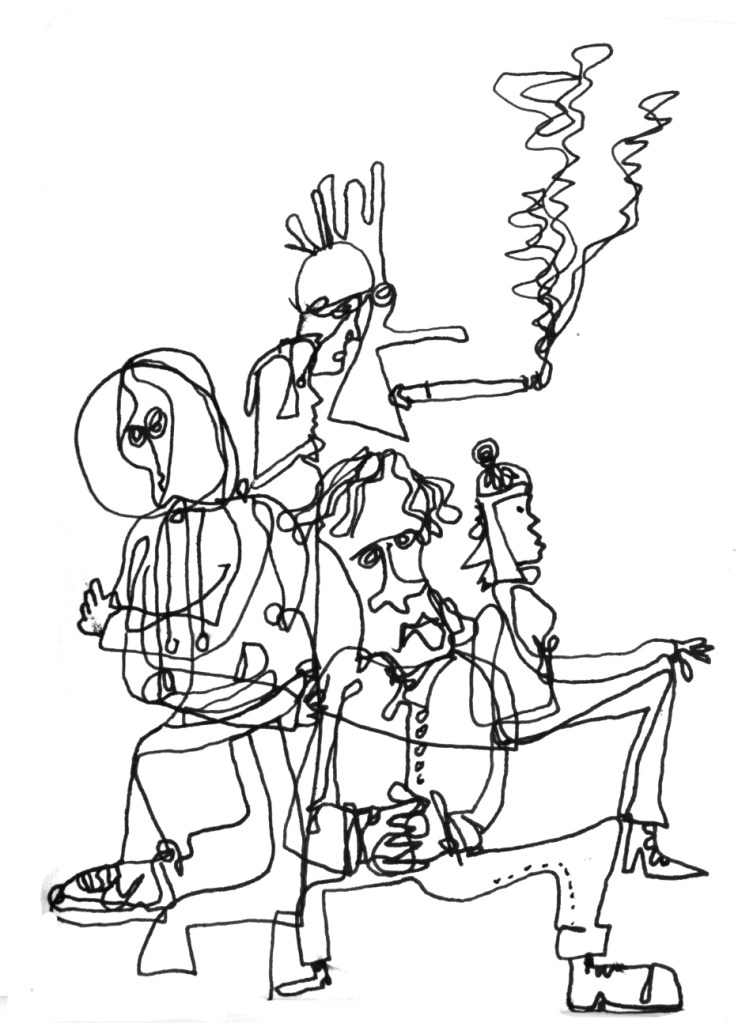
BOYS ON FILM

My phone is my camera. I like to be able to document things at any moment.

‘You’d shoot anything that moves,’ my girlfriend says.

The boys in a farmyard west of Bucharest weren’t interested in posing. Except one: Danut, smoking, staring at the camera with typical teenage nonchalance.

He sought me out after. ‘You should pay us for that,’ his English surprisingly good.

‘Would you like to see what I took?’ I asked.

He shook his head. ‘Money,’ he said.

But I showed him anyway.

‘Here,’ and he grabbed my phone, taking a moment to study the picture more closely, then deleting the image with a swipe of his finger. He handed me back the phone. ‘We’re not in a circus,’ he said.

‘I’m sorry,’ I said.

‘I can tell you are,’ he said.

I was walking away when he stopped me. ‘You could help me leave here. Take me to Bucharest, help me get a visa for the UK.’

‘No, sorry, I can’t help you; I can barely help myself. I’m on holiday, that’s all.’

‘Holiday: nice. You have cigarettes?’

‘Yes, I have.’

‘I do too,’ he said, lighting two and offering me one. ‘Smoking is good, makes you feel brave, like you can do anything.’

‘Look, I’ve got to go.’

‘Bye bye, Photo Man.’

‘That’s not my name.’

‘My name‘s Danut; Romanian for Daniel.’

When I got to my hire car I looked for my phone in my jacket pocket. It’d been swapped for a dead phone with no battery.

I walked back to the yard. Two boys were unloading animal feed from a truck.

‘Have you seen Danut?’

They looked at me and continued unloading.

‘Danut,’ I said, and then shouted it out ‘Danut!’, as I ran towards the barn.

He met me as I arrived at the barn entrance.

‘Hello, Photo Man.’

‘The name is Michael, and can I have my phone back?’

‘Photo Man suits you better.’

‘Okay, but I’d like my phone.’

‘If you let me take your photo you can have it.’

I wasn’t about to answer.

‘Clothes on or clothes off?’ he asked.

The two boys left the truck and came over. Danut chucked one of them my phone and came and stood beside me. ‘I was teasing, Photo Man. Here, Lucca will take a photo of us together,’ he said pulling me close, a fraternal arm over my shoulder. ‘Relax,’ he added, and so I draped my arm over his shoulder too: two pals together, GI’s on extended leave, gone AWOL.

The boy taking the photo laughed when he saw the result on the phone screen, and made exaggerated sucking sounds as he jabbed his finger in and out of his mouth.

‘He’s saying we’re faggots, Photo Man.’

‘Tell him to fuck off.’

‘No, I don’t think so,’ he said, still holding me.

I freed myself. ‘I must go. My phone, please!’

‘Here you are,’ and he took it from Lucca and placed it gently in my hand.

‘You should stay though; we’re cooking a chicken over the fire. Lucca is a good cook, believe it or not.’

‘I don’t believe it but thanks for the offer.’

He walked me to my car. ‘You’re missing out,’ he said, opening the driver’s door. ‘But you know where we are if you change your mind.’

‘Where you are,’ I said. As I was about to drive away, I realised I still had the other phone. I wound down my window. ‘I think this is yours.’

He laughed and took it. ‘Not a thief then, Photo Man.’

‘How come your English is so good?’

‘Stay, and I’ll tell you.’

‘No, it’s okay, I’ll leave it to the imagination.’


When I returned home a week later, Lila met me at the airport. We kissed and I patted her stomach. ‘How’s our chick doing?’

‘Thriving,’ she said. ‘I have a photo of the final scan in my handbag.’

‘Show me when we get home.’

She looked hurt for a moment, and then quickly righted herself. ‘You look wasted, what exactly did you get up to when you were away?’

‘I’ll tell you when we get home.’

‘Brought me a present?’

‘Would I be allowed in the country if I hadn’t?’


At home, my respite over, we fell back into our usual pattern, giving each other space when we were together, meeting at home after work to share a meal, some television and bed, walks and films at the weekend, the countdown to the new arrival ticking ever closer.

In bed we played the name game. We were onto ones beginning with D.

‘Girls’ names?’ she asked.

‘Deborah, Debbie, Desdemona, Deirdre ’ I replied and she laughed – I thought she’d have laughed at ‘Desdemona’ but it was ‘Deirdre’, the image of Deirdre Barlow in her eighties bubble perm and huge glasses shared telepathically between us. I continued: ‘Davina, Delilah, Doris,’ and she sniffed her disapproval.

‘Take it seriously, Mike, we’ve only a few months left. What about boys beginning with D?’

‘No, I said.’

‘No, to boys names beginning with D?’

‘We’re having a girl, I’m sure of it.’


When Leila arrived – my idea – we took thousands of pictures, and I mean thousands.

One morning when I returned home from the nappy run, I found Lila using my phone to take a photo of Leila as she lay on her back kicking her legs in the air.

‘I hope you don’t mind; you had no disk space left and so I had to delete some pictures. I found this one though, and she showed me: ‘Who is the boy and why do you look so odd?’

‘No-one,’ I said. ‘I was travelling near Bucharest and got talking to these farm workers. They asked me to stay and eat with them, that’s all.’

‘That was nice of them. Did you stay?’

‘Polite to.’

‘What did they cook?’

‘Chicken.’

‘Was it good?

‘Yes, I think so.’

‘That’s settled then. So, can I delete it?’

‘Yes,’ I said. ‘Delete away.’

*Boys on Film originally appeared on the site A Thousand word Photos and recently came second in the Plaza Prizes Sudden Fiction competition https://theplazaprizes.com/sudden-fiction-winners-top-3/

Posted in Uncategorized | Leave a comment

JENKINS

JENKINS

Jenkins fucked me on a beach at Dungeness and my knees carried the indents of pebbles for days after. I’d seen him the night before in a drag pub in Brighton, talking with some men at the bar. In a tight fitting blue T-shirt and jean jacket he was just my type.

I was eighteen, studying art at the Poly, and already drunk from a show when I arrived alone at The Mermaid that night. Jenkins told me later that he hadn’t seen me come in, though I couldn’t keep my eyes off him from the moment I got there. Watching him talking and smiling, inhaling on his cigarette, everything in my mind racing, telescoping towards him; but that may have also been down to the tab I’d just dropped. He was so at home with his casual, sly mannerisms, the hand on the shoulder of the man next to him, the gentle leaning forward to whisper something in his ear.

Jenkins said he only noticed me when I got up to do my Karaoke Nothing Compares 2 U, my party piece, but the Sinead O’Connor version, not the Prince one. He said I was like a siren, but he could hardly fail to have noticed me, I was singing it six feet from him, all the time staring straight into his eyes.

We got talking and within five minutes his hand was on my knee, his fingers travelling slowly up my thigh. I asked him about the blue anchor tattoo that lay on the soft crescent of flesh between his thumb and finger. He said he’d got it done in Amsterdam when he’d lived there in the seventies; but then he also said he was thirty-seven.

I talked so much, maybe it was the drugs or drink, but I just couldn’t stop. I told him about my real dad, a painter, who disappeared in the sea off Greece, and about my stepfather who liked to chase me round our kitchen. My mum would stand there, staring blankly as if she was watching television. I described theday when she did nothing to stop him, and how I left the house the following morning, never to return. Jenkins said nothing, but his eyes took everything in. They sparkled, a crystal blue, like the sun raining on the Aegean Sea. We shared a cigarette, and kissed.

I talked about my tattoo, a heart floating in a pool of sea, a pearl in the milk of its own shell, and how it lay secreted from view. I whispered that, if he was good, he might get to see it one day. He pushed his hands up between my legs and whispered that he had a thing for the gamine. ‘What?’ I thought. He said I reminded him of Jean Seberg. ‘Who?’ I said. That he loved my ash blonde wig and was turned on by the tiny rabbit hairs above my top lip. He said he could just imagine them when I got to sucking him off, and how talking about it now made him as hard as stone. All this should have jarred many things inside me, set off all kinds of alarm bells, but the truth is it didn’t, it turned me on.

After the pub we went to a club by the seafront but the queue was too long to get in. The acid I’d taken earlier was beginning to wear off and I felt tired. The bright lights of the pier all of a sudden went grey and dim. All I wanted was to do was to lie next to him, to feel the warmth of his body, to feel his skin on mine. I was shaking and could barely walk, but he steadied me along, his arms around me all the time.

I’m not sure how it was decided but I ended up on the back of his motorbike. He had a spare helmet, ready I guess for just such an occasion. I bet there had been many others. I liked that idea; it made me feel safe, even when he drove like a demon.

I could barely make anything out as we clambered the night up into the Downs, somewhere between sky and sea. Every so often, the forced revving of an engine groaned from behind climbing a hill, attempting to catch up, but no car ever passed us. They screamed by in the opposite direction though, their lights dazzling. I don’t know how he could keep control, let alone see the road. Brighton had long disappeared from view, its necklace of urban lights and fumbled memories blown from my brain.

Then there was nothing but the numbing sound of the motorcycle engine; my helmet squeezing against my head. As we drove on there were fewer cars, and those that there were signalled themselves with soft splayed out torches of light from high and afar, winding in and out of view along the hillside bends until they suddenly appeared in front of us, eyes of light beaming, then casting out shadows on the road, blackness enveloping us once more.

We drove for ages and I began to feel cold. I pulled my body closer to his, wrapped my arms tight around his stomach, my hands slipping into his jeans. I slid them down further and felt. He let me but showed no reaction in his body, no shudder, no little look round, just the occasional and sudden twitch of his cock. Each time it moved it made me laugh.

There were times that I thought I might fall asleep, and others when I felt like jumping off as fissions of electricity surged through me. A bolt of energy climbed through my body, the chill of night and ice on my nipples so exhilarating I thought I might never feel this good again; I just wanted us to stop and fuck.

At Dungeness, I got my wish. Nothing was said. We just went at it, roughly at first, then more gently, and I didn’t suck him off once. We lay up close, he inside me, and moved slowly as the waves lapped and dragged themselves up and down the pebbles, then back into the black of the sea.

As dawn arrived, in its thin grey light, we could make out the faint yellow beams of fishing boats on the horizon. As we craned our heads we could see a small blue boat chugging out from the beach. One of the fishermen saw us. He told his mates and they waved and whistled. We were naked, entwined. I got up and stood on a rock and waved back. Jenkins seemed not to care; he handed me a drag of his cigarette and looked away.

We got dressed and walked along the beach, skipping stones, and picking up driftwood. A man came near with a dog. Jenkins spoke to him. I petted the dog, the smell of seaweed on his fur reminding me of my dog, Charlie, that I’d had when I was a child before Dad ran away. I felt sad. Jenkins noticed, and when the man left, he pulled me close to him and kissed the back of my neck.   

We came across Derek Jarman’s wooden beach house with its strange natural, sculpture garden. Jenkins said he’d met him once, that he’d been something of a local character. I was eleven when he died, and I remember his film, Blue, being shown on television: a beautiful blank Klein-blue screen with only his commentary for explanation. My mum had turned it off saying it was ‘filth’, my stepfather adding that it was ‘a waste of a fucking licence fee’ – his words. ‘It’s channel fucking four, actually’ – my words as I climbed the stairs to my bedroom, leaving them to their whisky and shouting. I lay on my bed, sinking my head back into the pillows to drown them out, and looked up at my poster of the southern oceans, and dreamt of swimming, swimming way out to sea.

We drank tea in a cafe in the nearby fishing village of Winchelsea. Jenkins said he’d never seen anyone put so much sugar in their tea before. ‘Eight’s my record,’ I said. ‘Six is being boring.’  He smiled and gently pushed something across the table towards me. It was a stone from the beach. He must have found it when I wasn’t looking. It was ivory smooth, long and beautiful. ‘Does it make a noise when it goes off?’ I said, picking it up. He didn’t laugh, just wrapped his hands around mine, and the stone I held, and squeezed lightly. This was my moment, and though I knew he meant it more as an ironic, erotic keepsake to remind me of him, I just didn’t care, I’d never felt so wanted.

We got back to Brighton later that afternoon. Jenkins said he had to work. He didn’t tell me where. We kissed and when he left, he didn’t look back.

*

Every Thursday after then, I went to The Mermaid in the hope of seeing him. I asked the men at the bar if they’d seen him. I described him – the motorbike, the small tattoo on his right hand, his pale blue eyes. ‘But what’s his name?’ they’d say. I shrugged my shoulders; Jenkins was just a name I made up for him. Jenkins was originally the name of an art teacher who touched me at school. He got sacked, and looked a bit like my seaside lover, that’s all.

A few weeks later, I went back to the Winchelsea cafe, and walked along the beach to a spot where a blue fishing boat had recently sunk. There was a circle of marker buoys, and in the distance was Dungeness with its ugly concrete power station, shadowy against the sky. I stared at the waves and imagined Jenkins below, his slim body resting at the bottom, the small anchor on his hand settling slowly in the sand. I fantasised for a second of diving in and swimming down to join him, then thought about the sex we’d had on the beach. I felt inside my pocket for the stone he’d given me. I squeezed it hard; then threw it as far as I could out into the sea. 

  • Jenkins was published on Pulp.net and in Popshot Magazine, Issue 31, Spring 2021
Posted in Uncategorized | Leave a comment

RAHAD

RAHAD

‘I can offer you all kinds of everything, anything you want because I own nothing that I can call mine. All gone. Given away, stolen, spent.  I can give you my arms to hold you, my whiskers for a scratch or friendly embrace, my heartbeat to move your body to, my blood to make you live and grow. Take it, don’t thank me, don’t put a coin in my hat but live your life like you always meant to live it: with freedom, with bravery, with kindness.’

He said that, the filthy old foreign man on the steps of the church. But I could never hug him. He smelled. I might catch something. And anyway, he was after something. They usually are, aren’t they?: the beggars, rough-sleepers, refugees from life, outliers from our civilised world.

‘Don’t be afraid,’ he said. ‘I won’t bite.’ But I thought he might; rabies, gangrene, aids, the whole sorry lot − so, thanks a million for the offer, but I don’t think. I will.

‘You look lonely. Anyone ever told you that?’ he asked − all the time; all the bloody time.

‘I was a pianist once. Blessed hands, see.’ I saw, and, if they were delicate once, all I saw now was grime. ‘My mother taught me the piano, she brought her sensitivity. Bill Evans was my hero. I saw him play in Paris in 1967, that changed everything.‘

Bill Evans? I needed to go. And then I actually spoke to him:  ‘I need to go,’ I said.   I didn’t, of course, but I didn’t want anyone leaving work seeing me talking to him. The ones like Gary, who shouted across the road at him, ‘Heh, Bin Laden, I thought the yanks dumped you in the sea’; and his friend who mimed shooting him with a machine gun, ‘ppp ppp ppp!’ And then the laughter, I always hated their laughter.

‘My daughter was your age,’ he said − okay, here we go− ‘and one night, in a previous time, she and her friends at the university were taken away. We heard nothing for months until we received a call to go and identify their bodies.’ − this was too much. What the hell was he trying to do to my day?−‘Her name was Sara.’

That was my name. I told him: ‘My name!’

And that’s when he cried, tears trickling the dirt in a fine line down his face. Skin revealed.  ‘Salt,’ he said. ‘Tears taste of salt. Thank you, I needed that, to cry I mean.’

My brain was buzzing. Was he making things up? Was his daughter really called Sara? Did he somehow know I was Sara before he stopped me? Had someone told him? Was this some kind of wind up? Gary’s idea of a joke?

He pulled out a creased photo from his pocket: a brown, grey picture of a striking looking young woman with long dark hair, wearing a polo-neck-jumper. She was smiling at the camera; a wonderful vibrant smile. ‘I took it in Tehran, outside the university’, he said.  And then he produced another: the same girl seated on a bench by a younger boy, proud looking adults standing behind them – their parents?

‘Sara! My family! And that man was once me,’ he said, pointing at the father, with his fine suit and impressive black moustache.

‘What happened to the boy? Your son, I mean? And your wife, what happened to her?’

He pressed his hand on his heart.  ‘Here, with Sara, always here.’

I felt tired, suddenly dizzy. He moved his bags so I could sit on the step beside him.

‘It’s a horrible world,’ I said.

‘No, don’t say that, it’s the life we have.’

He offered me a bottle of water from his bag. ‘A kind person gave me this today, you look like you need it.’

‘Your English is so good.’

‘In our house, we spoke English often, French too.’

‘You must hate it here. ‘

‘Sara, don’t say that, I don’t feel hate.’

‘But the English distrust foreigners. Moslems particularly. ’

‘A few do, not many. Most try their best. I know this. And you do your best too. I see you on the way from work; you carry the world on your back. I feel your care, your sadness.’

‘I should go.’

‘Yes, of course, but you’re welcome to join me anytime.’

‘I don’t think . . .’

‘You will, if you need to, you will.’

‘Thank you . . . I don’t know your name.’

‘Rahad’

‘Bye, Rahad.’

‘Bye, Sara, and remember your name in Iranian means pure, pure of heart.’

I shook his hand. It felt so soft.

He’d been a fixture on the church steps all winter and I’d finally spoken to him.

I went looking for him the next day but he wasn’t there and wasn’t there any day after. He’d disappeared, the old man with the filthy clothes and delicate, soft hands encrusted in grime, the pianist, father, husband, son, with a name, Rahad.

Sara ‘means pure of heart’; that touched me.  I Google his name:

Rahad: ‘eternal traveller, a note of music.’

*

Rahad was originally written for White Rabbit’s Grenfell Refugee fundraising story night and was read there by the amazing Bernadette Russell.

Posted in Uncategorized | Leave a comment

COWBOYS

cowboys

I punched a dog, Dan.

You did, you punched a dog, Ned.

Punched him real good.

You did, yes, real good.

Should I shoot him?

If you like.

I don’t like.

Don’t shoot him then.

Don’t think I will.

Don’t think you will neither.

Either.

Neither.

But I might shoot you, Dan.

Not before I shoot you, Ned.


*picture by Jonny Voss


Posted in Uncategorized | Leave a comment

WHERE IS THE LIGHT?

Where is the Light?

The world in mustard hue, sun toxic, sky sulphurous, the dying of light. I come with two others, the last three standing. Frances manages to find enough water for us, has kept some tea back, scraped and rinsed mould from the dry leaves, and even has a jug of coffee warming on a portable gas burner. We’ll share it out, every last drop.

Mildred’s teahouse has stood in the middle of town long before I was born. It’s been through several re-vamps but has settled into its final incarnation for as long as I can remember: the bright breezy posters extoling good health and civic responsibility – ‘Don’t waste’, ‘Think before you litter’, ‘Visit your elderly neighbour with kindness and laughter’ – the tired jukebox playing old sixties and seventies songs, the same cheery satin wallpaper with forest animals in reverie chasing each other’s tails through the trees. For a long time, it existed as an outsiders’ community centre: lonely old people, young Mums with babies, poetically inclined teenagers (us bookish geeks) who rejected the local coffee chains and hipster cafes for somewhere that wasn’t trying too hard to be anything, it just was.

It‘s been run by an ex nun called Frances ever since her companion Mildred died, and tonight she beckons us in, locks the door and closes the blinds as soon as we’re safely inside, clusters of thunder dropping in the neighbouring valley rattling the windowpanes, sending plumes of charring smoke to smother the clouds. Soon they’ll be coming.

Frances speaks first: ‘I won’t ask you to pray, there’s no time for that. Just reach out to the person next to you and give them a hug.’

I hug old Bill Masterson; even though I’ve hated him since he aimed a shotgun at my friends and me when we were teenagers. We’d let down the tyres on his lorry because he was a bigot and was known to be cruel to his animals. But here he is up close, the stench of fear sweated through his shirt. I feel a tremble deep in the bones of his chest, a cool dampness on the skin of his arms, the weakening of what was once surely a fierce hand grip before he steps back and looks at me with small clear blue eyes and says ‘thank you, I’ve not felt another so close in years.’ A speckle of dried spit tacks like rubber onto the corner of his mouth.

‘How are you doing, Mister Masterson?’

His eyes narrow as he scrutinises me. I can tell he finds me familiar but can’t quite place me. It was years since he aimed the shotgun and I’d grown up, been away to university, and had only came back last year when we were ordered back to our home towns: ‘You’re Nicki Reardon, Charlie Reardon’s daughter,’ he says finally. ’I’m sorry about your parents, no-one should go like that, whatever they’ve done.’

‘No,’ I say. ‘Thank you.’

‘Why did you let down my tyres though, girl?’

‘Not now, Mister Masterson,’ I say, and lean closer to hug him again.

Last Christmas, his nephew, Gordon, had been standing on the opposite bank of the river, looking through a pair binoculars towards our house. I told my parents.

‘He’s a freak, a flag waver, ’ Dad said. ‘Just ignore him.’

‘There are too many like him. And why are they camping there?’ Mum said.

‘Crazy idiots, they’ll fall apart soon enough, start fighting amongst themselves, they always do.’

And then came a shot, fizzing through the lounge window, plugging into the far wall. A rapid series of shots followed, the pane splintering, then giving way, the wall crumbling.

I heard laughter, catcalls, others joining Gordon on the bank from the trees. They gave their sign and shouted: ‘black-loving leftie faggots going to be eaten by maggots!’ and a parting shot was fired, a bullet screaming past my ear.

In the café, Frances is on the piano. A Tom Waits song, a hint of Vaudeville, a dis-coordinate waver of the keys, an asthmatic rasp: ‘You’re innocent when you dream.’ She goes on to Nina Simone’s ‘Mister Bojangles’, getting out her favourites before the end and not a dry eye in the house.

‘Coffee tastes like poison. But welcome all the same!’ shouts Mister Masterson, standing up and holding his mug in triumph.

‘Sit down, Bill,’ barks Miss Wendy, my first primary school teacher, as firm as hell.

‘I’m thanking her, Wendy, thanking her.’

‘Well, make sure you do, and no trouble, we’ve done with trouble.’

‘Done with trouble’: the resigned understated expression of the old.

The shots had been a warning. Soon came the roadblocks. The bridge over the river was closed. We were quarantined. Starved. Electricity and phone lines cut. My parents were part of a group sent to negotiate. Days later, their bloated bloodless bodies floated back along the river, gaping tributaries of grey rotting flesh gouged into their necks.

I mourned as best as I could. But I couldn’t cry; it was too much to keep my senses together or even real. Fear blew through the town like a fever, hung to our clothes, and infected those of us who were left with a deranged and unfathomable anger that couldn’t come out, and, after a while, as the hunger and cold took hold, we drew lots for the firing squad, huddled in the queue for our procession to the final solution.

*

There’s a line from a Shangri-La song, often played on Mildred’s jukebox: ‘he’s good bad but he’s not evil.’ Okay, Mister Masterson wasn’t ‘good bad’; he was plain bad but maybe not totally evil. ‘Blacks should keep to their place but I don’t go along with killing them.’ That was his line, and he liked to say it out loud. Black people worked for him. ‘If just they do their job, we get along fine,’ he’d say. A racist, not a killer, but now he was labelled a collaborator, the lowest of the low, a classification that had led him to Mildred’s, apart from his neighbours, apart from his kind.

It was a hot night when we’d crept into the abattoir’s parking lot, the stench of dereliction and rotting carcasses seeping from his sheds. We daubed signs on his lorry, ‘Animal Killer’, ‘White Supremacist’, ‘Bow to the Holy Cow’, and let down its tyres.

He arrived into the night with the steel of a shotgun glimmering from the beam of his torch. ‘What’s going on?’ he yelled.

‘Retribution,’ we shouted and laughed, hiding behind some bins, near the outer wall of his yard.

But he was a wily old bastard, turned off his torch and snuck low into the dark. Soon, he had John by the scruff of the neck, dragging him into the centre of the yard. He turned the torch on his face, the barrel of the gun spotlighted at his temple.

‘John gets it if you faggots don’t show yourselves.’

One by one he started to draw us out. I was first.

‘A girl?’ he said. ‘What business has a girl misbehaving in the night?’ He looked down at John: ‘You ought to be ashamed of yourself bringing her here.’

But then his attention was taken by the last two to emerge: Marlon and Sheila. ‘Marlon Biggs and his bitch Trells! Both your fathers work for me, or at least they did until now.’

‘That’s not fair! Please, I’ll put right all we’ve done,’ said Marlon.

‘Fair, you want fair, I’ll show you fair,’ and he smashed the butt of the gun against the side of John’s head.

Marlon suddenly rushed him and the gun fired. A bullet ricocheted off the lorry into the chest of Mister Masterson’s dog that’d just appeared in the yard. We all stopped and Mister Masterson fell to his knees and let out a long anguished howl.

I noticed the worn scuffed soles of his boots, mud water seeping out of the cracks, the old bastard had worked them hard. His sobbing, the whimpering of his dog, his head bowed and defeated, we should have finished him off then.

I look at him now, crumpled in his seat, his fearful eyes flicking around to check we’re really okay with him, someone like him, being here, a distraction from his vigil, eyes trained onto the front door to see who might charge in.

Frances slowly dances around the room. Another Shangri-La song on the jukebox: ‘He’s the leader of the pack, vroom, vroom,’ she sings, directing her attention to Mister Masterson.

He grunts at her and shoos her away.

She beckons Miss Wendy onto the floor: ‘Come on, Wendy, why don’t you shape some moves like you used to?’

‘Have you gone mad?’ says Miss Wendy.

‘I have,’ she says. ‘Dregs left in heaven, coffee gone my brethren, but we know what we are about to receive and there’s no getting away from it, so I’d like some of the fun that’s owed me.’ She pulls down a rusty looking tea caddie from the shelf above the service counter. ‘Now the expiry date will be well passed but let’s not worry too much about that, shall we?’ She takes out a sheet of paper embossed in small orange squares. She peels one of the squares away from the sheet as if it was a stamp and places it on her tongue. ‘Ride the nausea, don’t let fear be your friend, just let it go and a better world will be revealed. I suggest one stamp for the uninitiated and two for those familiar,’ and she swallows another, and presents the sheet to me. ‘Nicki, take one and offer the rest around.’

I take one like a sacrament, and offer the rest to the others. ‘Mister Masterson, will you?’

‘Why not?’ he says.

‘Miss Wendy?’

‘I spent my life fighting against drugs, banning them from school, campaigning for better rehabilitation services for addicts so I’d be a hypocrite if I took one now.’

‘If you’re sure?’

‘Well, I’m not sure, Nicki, but you go ahead, I won’t report you,’ and she laughs, which sets Frances off, giggling and hooting like a hyena.

In the valley the sound of explosions and thunder roll closer. I am on a path amongst a line of squat trees – brown trunks, wooden table legs – crawling on all fours – ‘never crawled to anyone’ should be writ on my tombstone, unless I be a spider, which I’m not – Bill Masterson is under the table sobbing like a baby, his coat – his dog reborn – swaddled in his arms – ‘you’ll be okay, going to look after you from now on’, his hands seemingly covered in dog blood – ‘how do you know?’ – its colour, the pedigree, human blood is . . . and when I close my eyes I see it like a river spewing from my parents’ freshly opened necks – ‘Let it go’, ‘ride’ it out Frances advised – yellow mist, stomach fumes, could sick it up or wait – I wait, Miss Wendy looks on, her primitive features full of gnarly wisdom – ‘you’re a tree,’ I tell her and she nods and maybe she smiles too – Frances is dancing like a loon, teeth chattering, raising her spent shotgun over her head like an apache – ‘help’ I yell but not a word leaves my mouth – ‘I’m not your guide, girl,’ Frances replies – and then, all of a sudden, I’m in a clearing, the voices in my head momentarily silenced – I’m crawling into the centre of the room, thunder directly above, red flashes up close against the windows – crackling, cracking – is that smoke coming in under the door? – Bill Masterson and Miss Wendy skulk out of the jungle to join me. Wendy squats down and we all hold hands, Miss Wendy’s dry like bark – a tree! – we’re humming – I can’t make out the tune but we’re hitting the same note – celestial vibrations – and then the brightest of lights as they all charge in.

*Where is the light? was  Highly  Commended AN POST IRISH BOOK AWARDS SHORT STORY OF THE YEAR 2020

Posted in Uncategorized | Leave a comment

LAST NIGHT A DJ SAVED HIS LIFE

Amidst the noisy throng of a south London high street, he mouthed ‘Noel Edmonds’ at a white sports car blasting ELO into the blue sky. His mouthing was cartoonly graphic and didn’t pass unnoticed. Soon there was the sound of screeching brakes and the slamming of a tiny door.

‘Did you mouth Noel Edmonds at me!’

The voice was familiar, the jumper zigzag and colourful, the beard well kempt and gnomish. He decided to pretend that the Noel man wasn’t there by seeking the ‘off’ switch. When Noel man’s first punch landed he was transported back to the safety of Diddy David Hamilton – the near forgotten radio voice of middle England – saying ‘that’s all folks’ at the end of his programme he’d loved as a child.

Alan Freeman interrupted to record the next punch in a loud rock and roll baritone as if the fight’s commentary was being scrambled from an old seventies wireless. Soon he was being dragged onto the road for an old school DJ kicking. Noel man wore blue suede shoes and their soft upper cushion probably saved his life.

To rescue sensibilities from the Hairy Cornflake DLT, the Jeremy Clarkson of his day, he allowed Status Quo to shake him down. In faded jeans and jacket, plummeting out of a small town discotheque, rock and rolling all over the world, he fell into a hazardous state of four-chord slumber.

Later, he heard the treacle salivation of every household’s favourite son, Simon Master Bates on ambulance radio, telling some sop’s sob story to Leo Sayer’s ‘I won’t let the show go on.’ Of the violence he remembered nothing; the bruises on his face and arms rationalised as marks of a musical accident in the street, 10 CC’s ‘I’m not in love’ scampering around his mind and across his lips.

*

From the trendy nurse’s station tuned to Radio Six, he later heard the twittering of Manchester DJ’s Radcliffe and Maconie:

‘Mister Morrissey lived at number 22, their first single got to 22, and he first met guitarist, Marr, in a pub in Salford, also 22.’

‘Funny pub that; didn’t the barman keep a stuffed dog behind the bar?’

‘Jack Russell?’

‘Not the wicketkeeper, surely?’

‘No, but the landlord may have been a wippet keeper.’

Weeks seemed to pass as they warbled on. And then came salvation: ‘Hello, Lovely!’ It was an uncommonly nice voice, a kittenish Kate Bush voice. ‘Are you the man with a child in your eyes?’ No hint of chiding; it was as if she really wanted him to man up and join her. His pinkies twitched under the blanket in response; the best he could muster.

She bent over in her crisp physio’s uniform and craned close, a hint of forbidden apple soap, and whispered ‘Lover please, please come back’ into his ear and his little ear hairs collected themselves and waved back. She touched his arm before she left, her long delicate fingers – how he wanted them to brush all over his skin – reaching over to retune the radio.  

Radio Three: the invalid’s therapeutic station of choice, a themed setlist for the sea, Gambo’s twee twerpy Americanisms introducing Mahler’s Fifth; dangerous melancholic music to lose yourself in. Christ, he could have cried when the boat horn cut through the fog of strings and he imagined, perhaps through a memory of the Adagietto Movement’s in the film of Death in Venice, St Marks’ grand faded buildings emerging into view as he approached Venice from the grey expanse of sea. He was alone in a topsy-turvy gondola, the enfeebled Gustav von Aschenbach feverishly fantasising for Tadzio, the aquiline Polish boy satisfyingly and momentarily replaced in his mind by his singing physio. The blanket draped across his lap dampened in the rough, the sea chucking up, his heart beating in time with the waves punching against the boat. This time he was able to press the buzzer to call for help.                                                      

*

Later, recuperating in the garden at home, Radio 4 voices muttered from the kitchen, a middle class morphine, dulling the pain of his body and mind.

A large dog fox appearing as a dishevelled Noel Edmonds fox approached him across the lawn, slinky and raddled at the same time, his bearded jaw bruised and collapsing at its edges to show two yellow canine teeth, sharp and dagger like. The Noel Edmonds dog fox spoke first:

‘You should never have spoken my name.’

‘Never spoke it, I mouthed it.’

‘Semantics, you deserved your kicking.’

‘You’re not a fox at all are you?’

‘I am and I can bite.’

The Noel Edmonds dog fox jumped towards him with a high-pitched scream. He fell back in his chair so it jumped over him and into the kitchen. He managed to crawl over to close the kitchen door. The Noel Edmonds dog fox was furious and slavered and snarled at the window making mucky, sticky fox kisses against the pane.

The Archers started up on the radio, its prosaic rural theme tune having the effect of making him feel tired and dead at the same time. He was glad to be outside with the wild ex DJ beast and the banal drama left to compete inside.

‘Turn it over!’ he shouted at the Noel Edmonds dog fox, who did as he was told, and suddenly he was out in the night and on the street again.

He saw a white sports car speeding towards him, music throbbing from its sides and pounding from its floor.

A tall beardless man with impressive Lego hair climbed out of the driver’s side:

‘Hi, fella, I’m Mike Read.’

‘The music, it’s familiar. What is it?’

‘Bow Wow Wow!’

‘Where snakes in the grass are absolutely free?’

‘You got it.’

‘Travelling Wilbury’s?’

‘Roy Orbison.’

‘Roy Orbison! Thank you.’

‘Rock and roll, that’s your prescription from now on.’

‘You’re a musical doctor?’

‘I’m Doctor Feelgood.’

‘And I’m glad all over, yes I am.’

‘Yes, you are!’

**

Last Night A DJ Saved His life appeared on The Quietus https://thequietus.com/articles/16951-short-fiction-alan-mccormick-dj-saved-his-life

Posted in Uncategorized | Leave a comment

THE RUNNER

Last night you had been drunk, but not legless. You had checked your run in a camera shop window along the Strand. You were surprised by the uniformity of your stride; even after the altercation.

You had been at the work Christmas party. You had used alcohol to free up your self-expression. You liked yourself when you drank; you were funny. You had told jokes, some unusual, and had chatted up one of the secretaries from litigation – the one you’ve always liked, the one who looks up and smiles when she types, the one who last night told you she had a boyfriend. She had repeated this seven times, only because you kept saying, ‘have I died and gone up to heaven, because I see an angel standing before me?’

By the third time she replied she was no longer smiling, and by the seventh she had started to cry. You were shocked by this reaction and took yourself to the bar for a few vodkas, where you sang a song:

‘I could have been someone.’ Only no-one sang ‘and so could anyone’, it was all in your head, so you started shouting that she’d led you on and that women weren’t angels, they were rat-like witches with broomsticks for tails. That was when the security man – he had the acme smell of Brut and wore the uniform of a traffic warden – tapped you on the shoulder.

Was that the altercation? You can’t be sure, but blood from your fingers has left a tell tale imprint on your sheets this morning. Had you smashed a bottle? You can’t remember, but you do remember there was blood on the soles of your feet when you got in to your flat.

You were running out of the hotel when you saw your boss say something, and for some reason, maybe the zeitgeist of footballers spitting at each other, you spat at him. You missed but it hit his father, the septuagenarian President, and he had just stood there open mouthed. You were chased and your chest hurt, but your legs, your regular legs kept pumping.

As you ran into the night, you thought about the 1500 metres and your boyhood hero, Steve Ovett, infinitely preferable and sexier than that squirt Coe. As you imagined Steve Cram in chase you found yourself running down an alleyway. At the end of it, you bumped into a car: a police car.

A young policeman spoke polite young policeman lines:

‘You’re in a hurry, sir. Is everything okay?’

‘I’m perfectly fine, officer, I’m practising for the Olympics.’

That was the folly of drink speaking and you knew it as soon as you’d said it.

‘Very good, sir, but why don’t you calm down and stand still for a moment.’

You were jogging on the spot, getting fit.

‘I need to get home.’

‘What’s the hurry, sir?’

‘No hurry.’

‘You appear to be upset,’ he said.

‘I’m happy as Larry,’ you said, still pumping the spot.

You wanted him to say, ‘who’s Larry?’, but he didn’t, he just kept on:

‘Has something or someone upset you?’

Stalling was proving an irrelevance and so you took up the pistol start and ran. The other policeman emerged from the shadows and tripped you up. You went sprawling, saved your face with your hands, cut your fingers in the process.

The polite policeman helped you up. The tripper policeman, larger and scarier than the other, took up the baton; he had a loud squeaky voice like he’d sucked up a blast of helium: ‘Now stand still and bloody answer.’

Good cop, bad cop. Nice cop, squeaky cop.  You said the former.

‘No, both bad cops. Now what’s your name?’ asked Squeaky.

‘Steve Ovett,’ you said.

‘The runner?’ said Nice, taking back the baton.

‘Paul, I mean.’

They stared at you.

‘I have a race to get to.’

Nice then pointed out that you had a name badge on the left lapel of your jacket.

‘It’s not my name.’

‘Then that’s not your jacket, is it sir?’

‘No, it is my jacket; there was just a mix up with name badges.’

‘Who got yours: Mo Farah?’ asked Squeaky.

‘I have no idea.’

‘Shall we take it that your name is Paul McMasters, sir?’ said Nice reading from your badge.

‘If you like.’

‘Otherwise,’ Squeaky slipped in, ‘otherwise we could be asking you how you got to be wearing Mo Farah’s jacket.’

You were confused. You thought of Farah slacks, nice grey ones. They were smiling. A short moment passed without anything being said.

‘Do you realise it’s an offence to impersonate someone else?’ they said together like a comedy duo. Your head was full of Mike Yarwood. Squeaky continued: ‘and that it’s an offence to give false information to the police.’

‘And that anything you say from now on will be noted down in evidence and could be used should a criminal prosecution arise from any of your answers to our questions,’ said Nice, but no longer that nice.

‘I’m a solicitor,’ you said.

‘Not a runner?’ they said.

‘I’m a solicitor, I’m a solicitor!’ you repeated.

They took your name and address and you told them that you had got drunk and had disgraced yourself at the work Christmas party. You told them that you were still drunk and that you were ‘very, very sorry’. They seemed to like this; valued your candour and sense of remorse. They warned you about your future conduct and cautioned you that they would keep a record of the conversation for the duration of the night in case your details tallied with any disturbance or incident later. After that they would lose the paperwork.

Your legal brain liked that term ‘lose’ – short circuiting, a camaraderie transaction of the law amongst professionals; not making it up, just saving time. You thanked them and they offered to drop you at a night bus stop.

‘No. no,’ you said. ‘I need to get some air, Dave. You understand?’

Dave, the nice one understood, and Bruce, the other one grinned and did the Mo Farah sign with his hands on his head.

‘Run along now, Paul,’ they said, and you did.

So you had got to know their names, you must have been speaking to them for ages. So many gaps to fill: what exactly did you say and do to make them like you? You don’t know but you wish you hadn’t said you were a solicitor; you’re a legal assistant. They can check on things like that and then where would you be? You’re not sure of the answer to this but you can remember running down a street towards the night buses in Trafalgar Square, where you convinced yourself that it was a busy night, and that they weren’t going to be bothered to check on your details.

Revellers were everywhere and they all seemed drunk, alcohol fumes igniting the sky and the smell of perfume and male deodorant rubbing against you as people toppled into you. Brute pheromones and sweaty violence permeating off the packs of bouncers lurking in bomber jackets outside their clubs – splash it all over and dig you in the ribs down an alley way – you steered a wide berth and thought they looked like devil dogs, rotweillers like in Omen, pawing the sky and baring their teeth. One grinned at you and pointed and you gave him a V sign and upped your running pace to get away.

Girls in mini skirts and angry ice-pick heels formed into Conga lines that snaked in and out of your path. One pulled your tie and you wavered for a moment before breaking free. She called you Darren and said she’d snogged you in Cinderella’s. Then when she saw your face, she said ‘sorry mate’ and the other girls laughed, their naughty elf Christmas hats and tinsel jewellery shaking, shrill screams scraping up the buildings and into the night.

You pulled off your jacket and tie and put them in a bin. There was a reason beyond the heat of running; something to do with not being recognised. Might have been easier to just lose the badge, but soon your trousers were gone, too, and so you knew it was time you got on the bus. You found one of those single disabled seats on the ground floor by the door. The bus was full. Somehow you kept hold of your travel card and your mobile phone, ‘after all I’m not that drunk’, you kept saying to yourself.

You had told Dave and Bruce that you’d be walking home. And there you were on a bus. Technically that was a lie, another one. But then Crystal Palace was a long way to walk so they’d have known you were lying anyway.

‘Hardly credible at this time of night,’ you thought you remembered Bruce squeaking.

‘Shut the fuck up,’ you said.

You said it out loud and so everyone on the bus stared at you.

Then you looked away and pressed your face against the window. Soon you were passing the party hotel again. You wiped away the condensation from the glass. There was an ambulance and a police car; blue lights revolving at different levels, Dave and Bruce getting out of their car.

‘Fascists,’ you whispered against the glass, leaving the imprint of your kiss.

When the bus rolled into the garage the fluorescent lights inside flashed and the driver jabbed you on the shoulder.

‘Fuck off, Paul,’ he said.

He knew your name because during the journey you had kept shouting your name out, saying you were Paul Ovett, the little known brother of Steve.

You were in Crystal Palace now. Your flat was left at the top of the high street, but you went the other way. You found the stadium in the park. The air smelled sweet up there and the city blinked below like a million cats’ eyes. The all weather track had a fine orange powdery surface that scratched the soles of your feet. Barefoot, in boxers and vest, you were running like Zola Budd. Nearly four times round the track, 1500 metres, in less than five minutes. Not Olympic, but pretty good considering. You punched the black night air in victory as you crossed the line.

On the run home your mobile rang. It was John from accounts.

‘What happened to you, matey? We were worried about you, running off like a nutter. Went outside and looked for you and everything.’

‘Did you find me?’ you asked.

‘Uh? Anyway, you missed a cracking night. Old Mister Bert had a heart attack and everything.’

You remembered your spit.

‘Did they see who did it?’ you asked.

‘You’re toast, mate.’

You thought about the phrase.

‘Anyway, I’ve left with Sheila, the little typist from litigation. She’s just popped into a garage for the necessaries. Hope you don’t mind.’

The phone revolved in the night sky, a small tinny ‘sorry mate’ gasping out before it landed on the street in pieces.

It is morning. The alarm clock has been silenced; you will not be going into work.

‘Serve them right for having a party on a Thursday night,’ you tell yourself.

You see your feet sticking out of the duvet, fine orange dust between your toes. You notice the blood. You look around your room, your posters of runners – Steve Ovett, of course, with pride of place over the mantle piece, above the line of your junior cups and pendants.

Must keep hydrated; you go to the kitchen and fill up a pint glass with water. You notice the cuts on your fingers. Your heart turns and you feel sick. The only cure you know is to run. In your bedroom you open your wardrobe to look at yourself in the full-length mirror. You are naked, running on the spot, and you will stay there and run until everything has leaked out.

*versions of this story appeared in my book with Jonny Voss, ‘Dogsbodies and Scumsters’, and in the Liars League’s anthology published by Cherry Potts’ Arachne Press, ‘London Lies’. See actor Ray Newe reading it at a London Lies event: https://videopress.com/v/1rHDoK1w

I also read it at one of Jay Clifton’s brilliant Ace Stories nights in Brighton.

Posted in Uncategorized | Leave a comment

I AM A ROCK

I AM A ROCK

I may be an island too. Simon and Garfunkel’s song is playing at the start of year assembly. It’s 1976, the start of punk, and the spiky boys are sniggering. On stage, head-girl Melanie, straight spine, confident smile, has left the three top buttons of her polo shirt undone, either suggesting something fantastically illicit, a fragile trace of a newly bought bra, the soft line of her long neck, or merely that she’s feeling hot. 1976 was a very hot summer, still seeping its heat into all of us even in September.

When the song finishes, she addresses the shifting restless crowd, in particular the startled newbies: ‘don’t be a rock, don’t be an island, it’s okay to be scared, it’s okay to cry.’ A sob is released from deep within the hall. ‘Just, don’t go in on yourself. We’re here to help, swim over and talk to us. We won’t bite.’

Oh, bite, please bite!

Ridiculously responsible for her age, one day Melanie will run the country or at least become a BBC newsreader. From her sensible flat Clarks’ shoes, up her honed hockey brown legs, all the way to her ultra-polished straightened teeth, correct Home Counties vowels and righteous corporate stare, I’m madly in love with her.

I want to sneer at her homilies, her crass use of Paul Simon’s lyrics, but the words make my eyes smart, my cheeks prickle. I can’t help it:  I was the hall crier, a loner,  shut off in my head like I’ve been sentenced to isolation in a juvenile detention centre; an acned porn fantasiser, too scared to talk to a real girl, let alone sleep with one, but Melanie got through.

Three weeks later, she’s approaching me in the corridor before A’ Level English.

‘Martin, your fly’s undone,’ she says, and my skin flares chilli red as if suffering anaphylaxis.

‘Are you going to pull it up, or would you like me to help you?’

‘I want you to help me,’ I answer, before I have a chance to muzzle myself.

‘Martin, I didn’t know you had it in you.’

‘I don’t,’ I reply and for some reason that makes her laugh, and she moves closer, the sweet citrus smell of 4711, and pecks me on the cheek.

What Melanie saw in me, I never quite understood. Maybe I represented a kind of endurance test, a Duke of Edinburgh badge (she had one, along with several Blue Peter badges) to be gained for saving a school weirdo from social oblivion, carrying me from my rocky outcrop in the middle of the ocean to the sanctuary of her small town bed, where sex would be instructional (she had precise, near clinical demands), and remorselessly energetic. After we finished she’d always pat me on the back and say ‘well done’. Then we’d lie in bed and listen her radio, to news comedies mostly: Clement Freud and Willy Rushton jousting for the last laugh.

‘That bit was really funny,’ she’d say, in case I’d missed the joke.

My friends marvelled at the idea of us as a couple: ‘you and Melanie together, it just don’t compute, Martin. So, has she blowed you yet?’

Her friends just ranted and raged, the thought of their prodigal friend slumming it with someone who could barely speak. ‘Don’t judge a book by its cover,’ she said whilst squeezing a spot on my cheek, ‘Martin will surprise you all one day, he’s amazing!’

When I go to her house I get a taste of why she might be going out with me. In contrast to Melanie’s cool and collected public persona, home is a mess. Her father might as well be dead as he’s never there, and her mother, oh God, her mother:

‘Ah, Martin, you must be the boyfriend. Pleasantries over, are you fucking my daughter? Because if you are, good on you. Congratulations are due to all concerned, I’d say.’

‘Mum, shut up, please.’

‘See how she talks to me, Martin? No respect for anyone, don’t say I haven’t warned you.’

‘Come on, Martin, let’s go upstairs.’

‘And fuck like little bunnies?’ her mother calls after us as we climb the stairs.

In the bedroom I put my arms around her. ‘Is she always like this?’ I ask.

‘When she drinks, so, yes, she’s always like this.’

‘Fuck!’

‘Yes please, and make as much noise as you like.’

*

It’s 2000, all the ticker tape and party confetti from Millennium festivities has been swept away, as Melanie and I are about to celebrate sixteen years as a married couple. ‘Celebrate’ is the norm for the passing of such a milestone but it’s probably not quite the right term to use in our case – ‘millstone’ comes to mind.

We have two sons, Tarquin and Paul (after Paul Simon). Tarquin is fifteen and the eldest, and where Melanie and I are both tall and slight, he carries the nickname ‘Larder’ at school; and ‘Tank’ at his rugby club, where he plays in the back row for the adult first team. He shouts ‘C’mon’ as he barrels into the house, high-fiving me every time he sees me.

I am scared of Tarquin, and he knows it. A boundary was crossed just before his thirteenth birthday, when I was arguing with Melanie in the kitchen about whether we should buy him the most expensive rugby boots or a cheaper, more modestly branded but equally good pair. I was angling for the cheaper ones. The argument became heated and Melanie suddenly screamed out in frustration. Tarquin charged into the room, saw his mother in tears and strode over and slapped me hard across both cheeks.

‘Leave Mummy alone,’ he shouted.

Mummy said nothing and Tarquin left the room, still glaring at me.

‘Not again! A man never makes a woman cry unless he really has to,’ he continued from the other room. ‘I’ll be listening and watching from now on. You, Sir, are on borrowed time!’

Paul is two years younger. He’s fragile, unusually quiet and ‘artistic’ – a term Melanie likes to pun with ‘autistic’. ‘A nauseating drip’ according to his brother but he doesn’t drip much near me: ‘a selective mute’ (Melanie’s diagnosis), who has elected never to talk to me.

Melanie and I are experiencing what a magazine writing about a celebrity couple might describe as ‘relationship upheavals’. The conservative well-bred construct she built to survive her childhood has fallen apart. I am a disappointment to her (I was never amazing, that was a lie, and never surprised anyone), an easy outlet for her ire, particularly when she hits the bottle.

‘You are so bloody useless, Martin. I can’t tell you how close I am to leaving you or smothering you in your sleep.’ When she talks like that she (inevitably) begins to sound and look like her mother.

I go to a friend for advice. ‘Ooh, poor you, Martin. Sounds monstrous. Get her to a psychiatrist or just leave,’ he says. Rod is older than me but if I was hoping for the measured voice of experience, he’s the last person I should be speaking to. Melanie and he have never liked each other and he’s a recent divorcee experiencing a mid-life crisis. His predictable life choice after the break-up of his marriage has been to sleep with his much younger secretary. ‘Never felt better, keeps me up all night, wanting it. “Ooh, give it to me, big boy” she begs. I’m chafing down there all the bloody time, I can barely pee straight, and I ache everywhere but what a lovely ache it is.’

It all sounds painful, the word ‘chafe’ which he repeatedly uses (‘chafing, Martin, bloody chafing’) is ugly and reminds me of something you’d get after an overheated game of squash, whilst his misdirected peeing surely marks the onset of prostate cancer.

‘Chafing, Martin, I can’t tell you how rough it is but boy oh boy, what a girl!’

‘Shut up, Rod, it’s cancer, you have cancer.’

So, here we all are. Awful, aren’t we?

*

But it hadn’t always been like this.

Four years earlier, the country climaxing with 1996 European Championship fever (‘it’s coming, football’s coming home!’), and I’m driving the family down a long narrow country lane. Each time a car comes in the other direction I have to carefully manoeuvre ours out of the way. Melanie is usually an accomplished and vocal back-seat-driver but today she’s curiously quiet. The boys, who would normally take her critique as a cue to up the ante, to begin their own catcalls, are also miraculously silent. I drive expertly for once and we arrive unscathed at the pub car park at Barcombe Mills.

We‘re here to hire rowing boats to take down a tributary of the River Ouse. I’ve been dreading it, anticipating unremitting sulks for keeping the boys from a key match (England are playing Holland in the quarter finals today), my boating skills being ridiculed, tears (Melanie’s words can still made me sob), and the day descending into an abyss. But the children are excited and can’t wait to get on the boats.

We opt to hire two, with Melanie and I in one, the boys in another. They shoot away, Tarquin leading and encouraging Paul to oar in time with him, Paul quickly falling into an easy rhythm, both working together to change direction around the bends. Melanie and I are as incompetent as they are expert, and we fall about laughing as the bow of our boat, first, snags the drooping branches of a large tree, then hits the bank, catapulting us in the opposite direction from the boys. They row back to us, startled at first by our chaos and merriment, but when they see we were actually laughing together, they start laughing too.

‘Come on, useless bloody parents,’ says Tarquin softly. ‘Let Paul and me show you how it’s done.’

‘I wish you would because your father and I’ – and she winks at me – ‘have no bloody idea!’

*

In 2004, Tarquin suffers a catastrophic fracture of his right leg during a game, just as he’s about to make his breakthrough into the England Rugby B team. After several operations to re-build his leg, he’s lucky to walk again but his sporting career is over. He begins to self-harm, going at it with customary gusto, gouging his legs, chest and arms with any blade, sharp or blunt (oddly worse somehow) that he can lay his hands on. After becoming addicted to opiate painkillers, his rugby club pay for him to go to a residential addiction centre.

He’s been there for nine weeks and Paul has come down from university to join us for the fortnightly family therapy meeting. University must be doing something to Paul because I think he mouthed ‘hi’ to me when he first saw me. Melanie and he go to get drinks and I find Tarquin sitting waiting in the family meeting room. He looks smaller, becoming vulnerable as he shrinks, his scarred limbs, and skewed withered right leg half the size of his left.

‘Hi, Tank,’ I say.

‘I’m not Tank or Larder anymore; I thought you’d have got that by now. And, whatever possessed you and Mum to call me Tarquin, but I’m not him anymore either.’

‘What should I call you?’

‘Son, call me son.’

‘You want me to call you son, son?’

‘Just son will do.’

‘Okay, son.’

‘You don’t have to keep saying it.’

‘Sorry, son.’

‘Stop!’

I wish I could, but, however awkward it sounds, I like saying it too. I look at him and he smiles. My son smiling at me and I smile back.

Beatrice, the therapist comes in.

‘Has he told you that he’s been writing poetry? It’s very good.’

The ‘p’ word is instantly threatening but I remind myself that it’s my ‘son’ writing, not Tarquin wielding a pen like a hammer.

Paul and Melanie join us in the room.

‘Are you ready to share any of your poetry with your family?’

‘When they’re ready,’ he replies with a smirk.

The session reaches the stage where children are invited to direct comments at their parents, who are not sanctioned to reply.

‘Mum, you need to get a hold of yourself. You’re not your mother and you need to stop drinking,’ says my eldest son with newfound wisdom. I look at Beatrice for recognition or sympathy (I’m not sure which, I just want her to like me) but she steadfastly won’t meet my eye, and looks instead at my son, and then at Melanie.

‘Mum, you need to be nicer, even to Dad,’ chimes in Paul. I take this unexpected revelation as a cue to smile weakly at Beatrice again (definitely wanting sympathy now) but she stares right through me as if I’m not there.

Then it’s my turn to listen.

‘Dad, sometimes it feels as if you’ve left the building; not dead yet but not present,’ offers my eldest son.

‘A vacuum,’ adds Melanie.

‘Parents shouldn’t speak now,’ advises Beatrice, whilst glaring at me for some reason.

My eldest son continues: ‘you’re like a tunnel that everyone drives though.’

Beatrice nods, and I want to ask if anyone has put their lights on. Then she addresses Paul: ‘What would you like to say to your father?’

He looks at her. ‘I’d tell him that I need to keep my distance and that I’m afraid I’ll end up like him if I don’t.’

‘You need to look at your father and tell him that, not me.’

He does as he’s told. ‘Dad, I don’t want to be like you.’

It’s the first time he’s looked directly at me and talked to me in years.

‘Thank you,’ I say under my breath.

Later, I find Paul sitting on bench outside the entrance to the centre. I ask if it’s okay to sit next to him.

He nods and talks first, his words miraculous to me: ‘Dad, I don’t think any of us see you as a tunnel to drive through. It’s what happens here, we’re seduced by therapy speak. Tarquin’s been in here too long, that’s all.’

‘I don’t know, maybe your brother has a point.’

‘He may. Point is, have we ever been happy, Dad?’

‘At Barcombe Mills?’

‘Oh, yes.’ And he smiles.

As a woman passes us to enter the centre she whispers, ‘two peas in a pod,’ and disappears quickly inside.

After leaving the retreat we drop Paul at the station to return to university, and drive home. We walk into an empty house, its atmosphere deadened and quiet. We watch some aimless television in an attempt to relax and distract ourselves. For the first night I can remember, Melanie doesn’t take a drink. In bed we don’t, can’t talk, and even though she’s more restless than usual, she eventually falls asleep.

Hours later and however hard I try to, I just can’t sleep. Melanie slumbers on, her body coiled in a foetal position facing away from me. She looks so quiet and still that I get up and go round to her side of the bed to check she’s still breathing, just as I’d done with the boys each night throughout their childhood.

She stirs. ‘What the fuck are you doing?’

‘You were amazing at school. That speech you made.’

‘God! What are you on?’

‘I don’t know, I’ve been thinking, that’s all.’

‘Well, don’t, it doesn’t suit you.’

‘You look so lovely asleep.’

‘I think I preferred you at sixteen with your zip undone. At least it was intriguing.

‘Thanks.’

‘Nothing to thank me for,’ she says suddenly laughing, burying her head under the quilt so it shakes, the sound of her laughter lowered, as if she’s going underground. ‘And I was alive when you were the diligent nurse, but maybe you should have checked yourself first.’

‘I’m always checking myself,’ I say, disappearing under the covers too.

‘Oh, I see what you’re doing! Now, why don’t you take these off and make yourself useful?’

‘Is your mother downstairs?’

‘Mother is always downstairs’

‘Noisy or quiet?’

‘Yell all you like.’

She bites, I want to scream. And so I do.

*I am a Rock was published last year on the wonderful site Words for the Wild – see http://www.wordsforthewild.co.uk
Posted in Uncategorized | Leave a comment

THE PARTY

21 THE PARTY


It really was a miserable party, it really was.

Young Hilary Stoppard and his pretentious young set contemplated the splenetic corners of art’s responsibilities within a splintered decaying cosmos.

Under an ageing Soviet philosopher’s smoke exhalation they gathered in an umbilical circle to soak in each of his puritanical philosophisings: ‘believe in the rhythmic order of your heartbeat and trust no creation younger than your least favourite aunt or neighbourhood spinster.’

Hilary’s girlfriend, Bunti, corrected her spine with a long natural breath and a complex re-interpretation of Alexander technique. Sigmund, who suffers from total-allergy syndrome, adjusted the valve feeding oxygen into his astronaut suit and wondered if air was in itself a poison more potent than Velcro.

The deflated clown behind the punishing philosopher wore a look of utter defeat, his soul carrying the angst of the world in its tiny blue sac.

Hilary Stoppard looked out into the everywhere and imagined himself more than himself but less than an atom.

It really was a miserable party, it really was.


  • picture by Jonny Voss


Posted in Uncategorized | Leave a comment

CRAB and GULL

Fester Crab and Benjamin sparred all summer and autumn, trying to pluck a feather or pierce a shell. One bright December morning they met for a last hurrah before their beach was carried away on winter’s drifting sand.

‘I hold my claws up to you, Benjamin, and offer you the dance of peace.’

Fester danced a circle and Benjamin Seagull watched.

‘Old adversary and now dear friend, you dance well for a crab. But it’s time for me to say my goodbyes and bid you one last farewell.’

Benjamin Seagull flapped his wings and flew into the opulent blue sky.

Crab and Gull

‘I hadn’t finished my dance. Typical of Benjamin to leave before all was said and done.’

At that moment Fester felt a tiny pain on his left side.

Most likely a heart attack’, suggested a medical crab at his funeral. ‘It was probably brought on by a change in the weather.’

‘The cold,’ said Benjamin. ‘Fester never liked the cold.’

In his will Fester left his protective shell to Benjamin, who wore it on his back until it dropped off during a violent storm near Newfoundland.


*picture by Jonny Voss. A slightly different version of Crab and Gull was in our book ‘Dogsbodies and Scumsters’ and will be published on Words for the Wild on January 22nd.

Posted in Uncategorized | Leave a comment